Barley Roller Mill
Barley does not always need to be finely ground before being used in animal feed. In many cattle feed applications, the grain is processed by rolling rather than grinding it into fine particles.
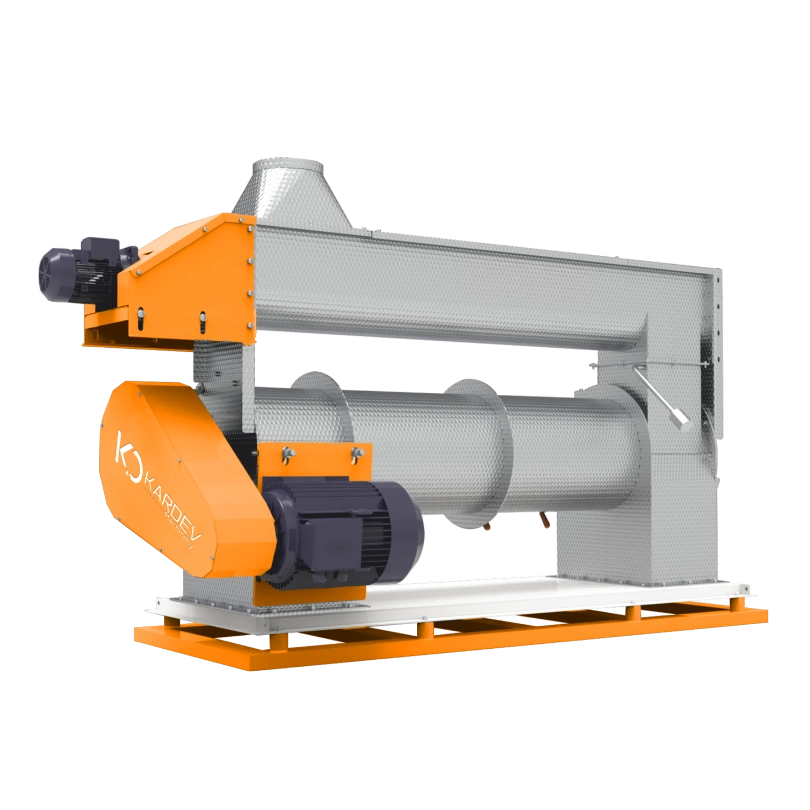
The KARDEV Barley Roller Mill is designed to crush and flatten barley kernels between two rollers. This process opens the grain structure and increases the exposed surface area while allowing the required degree of crushing to be adjusted. The machine is used in feed production lines where rolled barley is required.

What Is a Barley Roller Mill Used For?
A barley roller mill processes barley by passing the kernels between two rollers. As pressure is applied, the outer layer of the grain breaks and the kernel becomes flatter, exposing more of its internal structure.
Unlike fine grinding, which reduces grain into small particles, barley rolling is intended to produce a coarser, flattened product.
Rolled barley is commonly used in cattle feed production, where grain processing is an important part of ration preparation.
The quality of the output is assessed by examining the processed kernels. Excessive fragmentation may indicate that the barley has been crushed too heavily. If too many whole kernels remain, the rolling process may be insufficient.
How Does a Barley Roller Mill Work?
Barley enters the machine through the feeding system and passes between two rollers. The pressure generated between the rollers crushes and flattens the kernels.
Depending on the production method, barley can be processed dry or prepared through moisture conditioning before rolling.
The final product is mainly influenced by the roller gap, barley moisture content and feeding conditions. These parameters affect the degree of crushing, product consistency and the amount of fine particles produced.
- Feeding System
The feeding system delivers barley to the rollers and allows the material flow to be regulated.
A steady and evenly distributed feed is important for consistent rolling. Excessive material flow or interruptions in feeding may affect the quality of the processed barley.
The KARDEV barley roller mill includes a sliding gate between the feeder and the rollers. This gate allows the material flow to be shut off when required.
- Roller Gap Adjustment and Product Thickness
The distance between the rollers determines how much pressure is applied to the barley kernels.
A narrower roller gap produces a more heavily crushed product, while a wider gap generally results in coarser rolled barley.
Roller settings should be evaluated together with the actual product leaving the machine. Changes in barley moisture may affect the rolling result even when the mechanical settings remain unchanged.
KARDEV barley roller mills are available with manual or automatic roller gap adjustment.
- Roller Diameter and Width
Roller dimensions are important factors in the design and capacity of a barley roller mill.
A wider roller provides a larger working surface for processing barley. Roller diameter influences how the kernels enter the gap between the rollers and how they are compressed.
However, roller width alone does not guarantee higher production capacity. If barley is not distributed evenly across the working surface, part of the roller may remain underutilized.
For this reason, machine selection should consider the required throughput, roller dimensions and feeding arrangement together.
- Integration into Feed Production Lines
The discharge arrangement should be considered when integrating a barley roller mill into an existing feed production line.
Depending on the plant layout, processed barley may be transferred to a storage bin, mixing system or another downstream process.
The KARDEV barley roller mill can be integrated with existing material handling and storage equipment according to the requirements of the production line.
What Determines Barley Roller Mill Capacity?
The hourly capacity of a barley roller mill depends on several operating factors, including roller dimensions, barley moisture content, feeding rate and the required degree of crushing.
The actual processing capacity should therefore be evaluated under the intended operating conditions rather than based on roller dimensions alone.
- Roller Dimensions
KARDEV barley roller mills use heavy-duty, wide rollers designed for barley processing.
Increasing roller width provides more working surface for material processing, provided that barley is distributed properly across the rollers.
The relationship between roller diameter, width and material feeding must be considered when determining the appropriate machine size.
- Feeding Rate
The feeding rate determines how much barley enters the rolling section during operation.
Excessive feeding may cause material to accumulate at the roller inlet, while insufficient feeding can leave part of the working surface unused.
The objective is to maintain a continuous and controlled flow of barley without overloading the machine.
- Barley Moisture Content
The moisture content of barley affects how the kernels respond to roller pressure.
Dry barley may break into smaller fragments and produce more fines during processing. Properly conditioned barley may flatten more uniformly, depending on the moisture level and rolling settings.
For this reason, dry barley and moisture-conditioned barley may produce different results even when the same roller gap and feeding rate are used.
- Degree of Crushing
The required degree of crushing is another factor affecting machine throughput.
Producing more heavily crushed barley may require a narrower roller gap and different operating settings than producing coarser rolled barley.
As a result, the same machine may achieve different hourly capacities depending on the required final product.
Technical Features of the KARDEV Barley Roller Mill
The KARDEV barley roller mill is designed for controlled barley crushing in animal feed production lines.
Its main operating features include:
- Heavy-duty rollers: Wide rollers provide the working surface required for processing barley.
- Adjustable feeding system: The material flow to the rollers can be regulated.
- Sliding shut-off gate: A gate between the feeder and rollers allows barley feeding to be stopped when required.
- Manual or automatic roller gap adjustment: The distance between the rollers can be changed according to the required degree of crushing.
- Production line integration: The machine discharge can be connected to compatible conveying, mixing or storage equipment.
After changing the roller gap, the processed barley should be inspected to verify the desired crushing result.
Where Are Industrial Barley Roller Mills Used?
Barley roller mills are used in animal feed production facilities where barley needs to be crushed or flattened instead of being finely ground.
One of their main applications is the preparation of barley for cattle feed.
In industrial feed mills, a barley roller mill may operate as part of a dedicated barley processing line. On-farm feed production facilities may use the machine to prepare barley before it is incorporated into feed rations.
Depending on the production process, rolled barley can be transferred to storage, mixing equipment or another section of the feed production line.
How to Choose the Right Barley Roller Mill
Selecting a barley roller mill requires more than checking its nominal hourly capacity.
The required output quality, plant layout, roller adjustment method and compatibility with existing equipment should also be considered.
- Required Production Capacity
The first step is to determine how much barley must be processed per hour.
The roller mill should be capable of handling the required flow, but the capacity of upstream and downstream equipment is equally important.
If conveyors, elevators or storage systems cannot handle the same material flow, bottlenecks may occur even when the roller mill has sufficient capacity.
- Required Rolled Barley Quality
The desired structure of the processed barley should be defined before selecting the machine.
Some feed production lines require more heavily crushed barley, while others need a coarser, less flattened product.
These requirements influence roller gap settings and may affect the achievable processing capacity.
- Manual or Automatic Roller Adjustment
KARDEV barley roller mills can be configured with manual or automatic roller gap adjustment.
Manual adjustment may be suitable for production lines where the required product structure remains relatively constant.
Automatic adjustment can offer greater operational convenience when roller settings need to be changed frequently.
- Installation Space and Connection Points
The available installation area must be evaluated together with the machine inlet and outlet positions.
Existing bucket elevators, conveyors and storage equipment should be considered when determining the most suitable machine location.
Depending on the plant arrangement, installation may require only minor connections or additional modifications to the material handling system.
- Spare Parts and Technical Support
Spare parts availability and after-sales technical support are important considerations when selecting industrial feed machinery.
The availability of replacement components, delivery times and service requirements can directly affect production continuity.
KARDEV supports customers not only in machinery supply but also through spare parts and after-sales technical assistance, helping feed producers maintain reliable production operations.
OTHER PRODUCTS
Quality is never a coincidence.