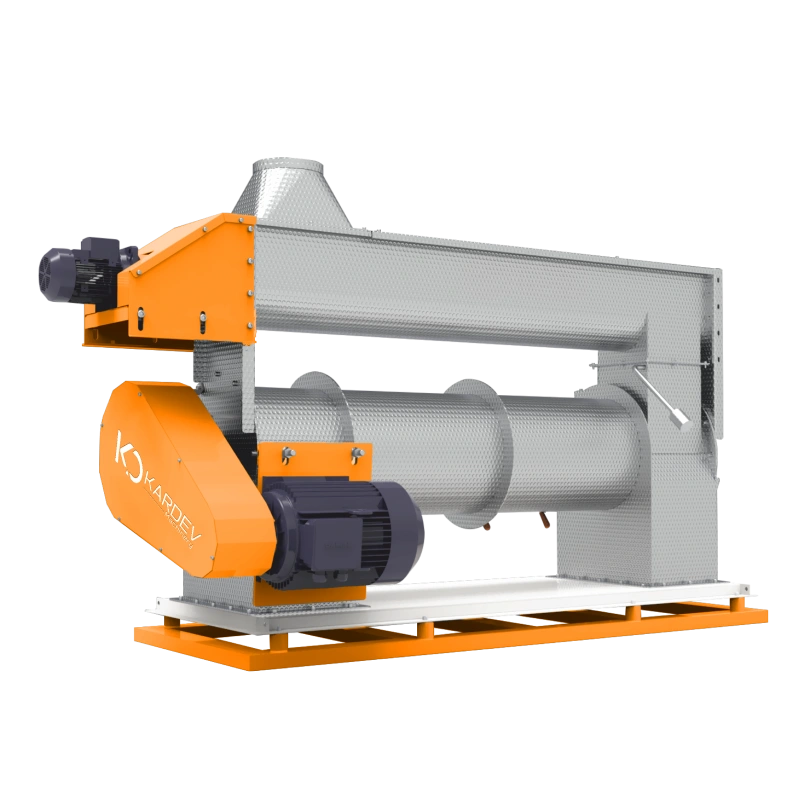
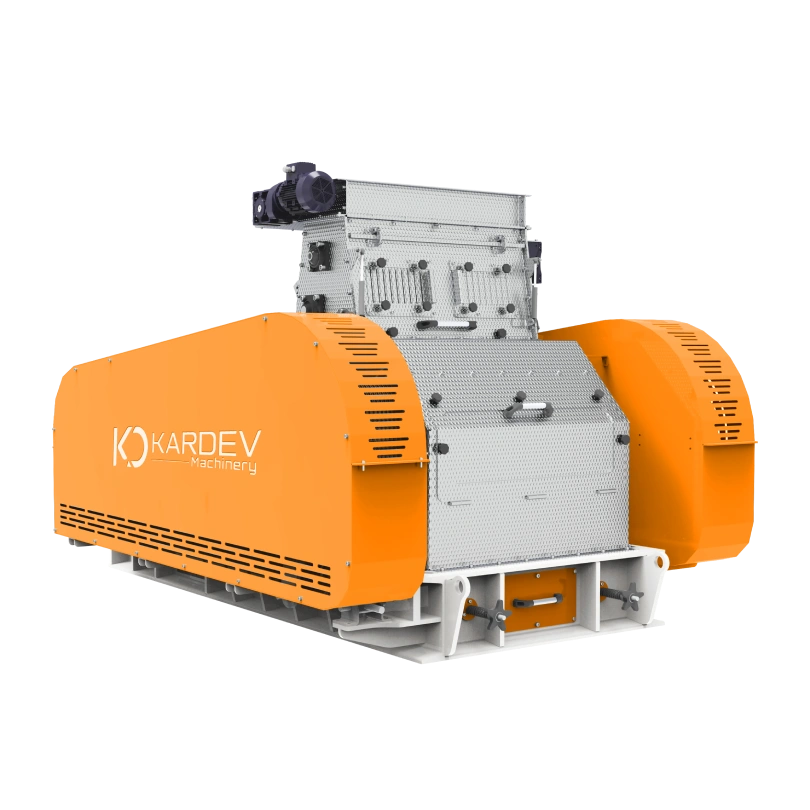
Counterflow Pellet Cooler
A pellet cooler reduces the temperature of hot pellets discharged from the pellet press before they are transferred to storage or to downstream equipment in the production line. It is installed after the pellet press. During the cooling process, air is drawn through the pellet bed. Heat from the product is transferred to this air, while part of the moisture contained in the pellets is also removed.
The objective is not to reduce the pellets to the lowest possible temperature. What matters is bringing the product temperature close to the ambient temperature. The actual outlet temperature may vary depending on ambient air conditions, pellet characteristics, and the operating conditions of the production line.

What Is a Pellet Cooler and What Does It Do?
If hot pellets are transferred to a bin or packed before they have cooled sufficiently, the temperature difference between the product and the surrounding environment may cause condensation. This can lead to moisture problems during storage and condensation inside the bin. The primary function of the cooler is to bring the pellets to suitable conditions for downstream handling and storage.
Hot pellets at the cooler outlet do not always mean that the fan airflow is insufficient. The residence time of the pellets inside the chamber and the way air passes through the pellet bed must also be evaluated. If air passes more easily through one section of the bed, pellets in other areas may leave the cooler before they have cooled sufficiently.
At KARDEV, pellet cooler selection is not based solely on capacity in tons per hour. Pellet press outlet temperature, pellet diameter, and the characteristics of the pellet bed formed inside the cooling chamber are also taken into account. The fan and aspiration system are selected accordingly.
How Does a Counterflow Pellet Cooler Work?
In a counterflow pellet cooler, hot pellets and cooling air move in opposite directions. Pellets enter the cooler from the upper section and move downward. Cool ambient air is drawn into the pellet bed from below and passes upward through the product. As the air moves through the pellets, it absorbs heat and removes part of the moisture from the product.
By the time the pellets approach the lower section of the cooler, they have already lost a significant portion of their heat and encounter the coolest incoming air. The air moving upward becomes warmer as it passes through the pellet bed. This means that newly introduced hot pellets are not exposed directly to the coldest air. Instead, the product temperature decreases gradually as the pellets move downward through the chamber.
Cooling time is closely related to the product level inside the chamber. In KARDEV counterflow pellet coolers, adjustable level sensors on the cooler body allow the residence time of the pellets inside the machine to be controlled. When the product reaches the predetermined level, the discharge system is activated. Cooled pellets are discharged from the lower section while hot pellets continue to enter from above.
How Is Pellet Cooler Capacity Determined?
The first parameter considered when selecting a pellet cooler is the amount of product discharged from the pellet press per hour. However, determining cooler capacity based only on tons per hour is not sufficient.
The calculation takes into account:
- Pellet diameter
- Product bulk density
- Pellet press outlet temperature
- Pellet residence time inside the cooler
As the amount of product coming from the pellet press increases, the cooler must be able to hold that product in the chamber for the required cooling period. If the product is discharged too early, the required throughput may be achieved, but the pellets may continue to the next stage of the line without being sufficiently cooled.
As pellet diameter increases, it may take longer for heat at the center of the pellet to reach the outer surface. Bulk density, meanwhile, affects the volume occupied by the product inside the chamber. Two products with the same weight may not occupy the same volume.
As the amount of product in the chamber increases, the height of the pellet bed through which the air must pass also increases. For this reason, fan capacity and airflow requirements must also be evaluated when determining pellet cooler capacity.
What Should Be Considered When Selecting a Pellet Cooler?
When selecting a pellet cooler, both the characteristics of the pellets to be produced and the operating conditions of the plant must be considered. At KARDEV, the actual operating capacity of the pellet press and the products to be manufactured are evaluated together when selecting the machine.
Pellet diameter is one of the important parameters. Since pellets of different diameters do not cool in exactly the same way, the required residence time inside the cooling chamber must be evaluated accordingly.
The fan system must also be properly matched to the cooler. Providing sufficient airflow is important, but it is equally important that the air can pass through the entire pellet bed. Uniform distribution of the product inside the chamber and correct installation of the aspiration system directly affect cooling performance.
The installation location of the machine should also be considered during the planning stage. Sufficient space is required for the upper product inlet, lower discharge, and aspiration line. If a cooler is to be added to an existing production line, accurate site measurements are particularly important.
What Should the Pellet Temperature Be at the Cooler Outlet?
There is no single outlet temperature that is correct for every pellet plant. The target value depends on the ambient temperature. In KARDEV pellet coolers, the objective is to reduce the product temperature to approximately 5°C above the ambient temperature inside the plant.
For example, if the ambient temperature is 25°C, a pellet outlet temperature of around 30°C may be expected under suitable operating conditions. When the ambient temperature changes, the target outlet temperature also changes. Therefore, especially during seasonal transitions, cooler performance should not be evaluated solely by comparing the current outlet temperature with previous readings.
In KARDEV pellet coolers, outlet temperature can be monitored using sensors. If the pellets leave the cooler warmer than expected, the fan is not the only component that should be checked. Pellet residence time and the way air passes through the pellet bed should also be evaluated.
Why Do Pellets Lose Too Much Moisture During Cooling?
As the pellet temperature decreases inside the cooler, part of the product moisture is also removed. However, excessive airflow or unnecessarily long residence time can increase moisture loss.
In KARDEV pellet coolers, fan settings are adjusted according to the amount of product being processed. If more air than necessary passes through the pellet bed, the product may dry more rapidly. The same applies when the pellets remain inside the cooler longer than necessary.
Pellet press outlet temperature and pellet bed height also affect moisture loss. Moisture inside hot pellets moves toward the surface and is removed as air passes through the product. If airflow is not distributed evenly throughout the chamber, greater moisture loss may occur in certain areas. For this reason, both product temperature and moisture content should be checked at the cooler outlet.
What Happens If the Cooler Capacity Is Lower Than the Pellet Press Capacity?
In a pellet production line, the capacities of the pellet press and pellet cooler must be properly matched. If the pellet press produces more material than the cooler can handle, the product level inside the cooling chamber begins to rise. As production continues, the cooler may become a bottleneck that limits the capacity of the entire line.
It may be possible to lower the product level by increasing the discharge rate, but this reduces the residence time of the pellets inside the cooler. If pellets are discharged too early, their internal temperature may not decrease sufficiently. A cool outer surface does not necessarily mean that the center of the pellet has also cooled adequately.
If this condition continues, hot product may reach the packaging or storage section. Even if the problem is first noticed at the end of the production line, the underlying cause may be a capacity mismatch between the pellet press and the cooler.
What Are the Main Parts of a Pellet Cooler That Require Maintenance?
Pellet cooler maintenance is not limited to lubricating moving components. Problems with the product distributor, discharge system, level sensors, or airflow system can directly affect cooling performance.
In KARDEV pellet coolers, the product distributor must remain clean and operate freely. If pellets are not distributed evenly inside the chamber, the product level may become higher on one side, resulting in uneven airflow.
In addition:
- Product accumulation or loose connections in the discharge mechanism can restrict movement. This can change the product level inside the chamber and alter pellet residence time.
- Dust accumulation on level sensors can affect measurement accuracy. Incorrect sensor readings may cause the discharge system to activate too early or too late.
- The fan, aspiration ducts, and cyclone should be inspected as part of the airflow system. Fine particles can accumulate over time and restrict airflow, reducing the actual air volume even when the fan is operating.
- Bearings and the gearbox should be inspected if unusual noise, vibration, or mechanical resistance is detected. If the cooler will remain out of operation for an extended period, no product should be left inside the chamber.
Custom Pellet Cooler Solutions by KARDEV
At KARDEV, pellet cooler selection is based on more than nominal hourly capacity. Pellet press capacity, pellet diameter, outlet temperature, bulk density, required residence time, airflow requirements, and plant layout are evaluated together.
For new pellet production lines, the cooler, pellet press, and aspiration system are considered as part of the same process. For existing plants, site dimensions, product inlet and discharge points, and the available aspiration arrangement are taken into account when determining the suitable cooler configuration.
To determine a pellet cooler suitable for your project, you can share your production capacity, pellet diameter, pellet press outlet temperature, and plant layout information with KARDEV.
OTHER PRODUCTS
Quality is never a coincidence.