Steam Conditioning Tower
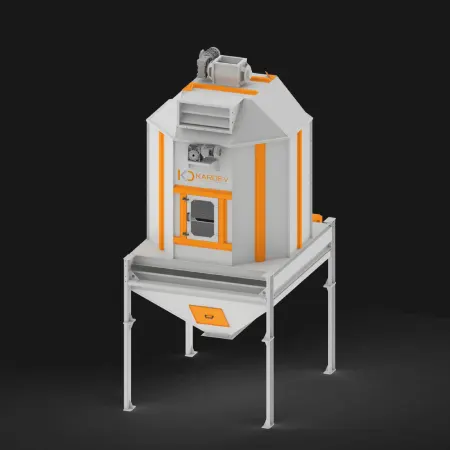
A steam conditioning tower is used in a flaking line to prepare grain before it enters the flaking mill. Corn, barley and similar grains absorb heat and moisture inside the tower, softening the kernels and helping them form more uniform flakes with less breakage.
KARDEV steam conditioning towers distribute saturated steam at different levels throughout the grain bed. Tower volume is selected according to line capacity, grain type and the required conditioning time.

What Is a Steam Conditioning Tower?
A steam conditioning tower, also referred to as a steam chamber or steam tower, prepares corn, barley and other grains for the flaking process.
The grain remains in contact with steam for a controlled period. During this stage, its temperature and moisture increase, making the kernels softer and easier to flatten between the rolls.
If grain reaches the flaking mill without sufficient conditioning, breakage and fines may increase and the required flake structure may not be achieved.
Steam conditioning does more than heat the grain. The combination of heat and moisture also supports starch gelatinization during the subsequent flaking process.
How Is Grain Conditioned with Steam?
Grain enters the upper section of the steam chamber and moves gradually downward while saturated steam is introduced at different levels.
KARDEV steam conditioning towers use ring-type steam distributors to help spread steam more evenly through the grain bed and reduce uneven conditioning.
Steam addition is adjusted according to the grain being processed. Corn, barley and oats may require different operating conditions.
At the tower outlet, grain should have suitable temperature, moisture and softness for stable feeding into the flaking mill.
Why Are Temperature, Moisture and Retention Time Important?
Steam conditioning cannot be controlled by a single parameter. Grain temperature, moisture and retention time should be evaluated together.
If steam addition is too low, kernels may leave the tower too hard and break more easily between the rolls. Excess moisture, on the other hand, may cause sticking or irregular flake formation.
If grain moves through the steam chamber too quickly, heat and moisture may not have enough time to penetrate the kernels.
For this reason, steam adjustment should be based not only on valve position but also on the condition of the grain at the tower outlet and the resulting flake quality.
How Is Steam Conditioning Tower Capacity Determined?
The main consideration when selecting a steam conditioning tower is the hourly capacity of the flaking line.
The tower must provide enough working volume to handle the required throughput while maintaining sufficient retention time. As line capacity increases, a larger tower may be required to preserve the same conditioning period.
If the steam chamber is too small, grain may pass through too quickly and reach the flaking mill before sufficient conditioning has taken place. An unnecessarily large tower increases equipment size, plant space and investment cost.
KARDEV steam conditioning towers can be manufactured in volumes from 5 to 25 m³. The required volume is selected according to flaking capacity, grain type and conditioning time.
How Does Insufficient Conditioning Affect Flake Quality?
Insufficiently conditioned grain remains harder when it reaches the flaking mill. The kernels may not open properly between the rolls, resulting in greater breakage, more fines and less consistent flake thickness.
In this situation, changing only the roll gap may not solve the underlying problem. Steam addition, grain condition at the steam chamber outlet and retention time should also be checked.
Which Grains Can Be Processed in a Steam Conditioning Tower?
Steam conditioning towers are commonly used in corn and barley flaking lines. Oats and other suitable grains may also be processed depending on the application.
Operating conditions are influenced by:
- Initial grain moisture
- Kernel hardness
- Hourly production capacity
- Required flake structure and thickness
When the grain type changes, steam addition and conditioning time should be adjusted accordingly.
How Should Steam Be Distributed Inside the Steam Chamber?
Uniform steam distribution is important for consistent grain conditioning.
KARDEV uses ring-type steam distributors positioned at different levels of the tower to help distribute saturated steam more evenly throughout the grain bed.
Steam flow control and steam shut-off serve different purposes. Suitable regulating or control valves may be used to adjust flow, while on-off valves can be integrated into the automation system where required.
Depending on the steam system design, strainers, steam separators, steam traps, check valves and other auxiliary equipment may also be included.
Why Is Stainless Steel Used in a Steam Conditioning Tower?
The interior of a steam conditioning tower operates under continuous exposure to heat, moisture and steam. Corrosion resistance is therefore important, especially on product-contact surfaces.
KARDEV uses stainless steel in product-contact areas of its steam conditioning towers. This improves durability under hot and humid operating conditions and also makes cleaning easier.
Thermal insulation is applied to reduce heat loss and help maintain more stable process conditions.
How Is the Steam Tower Matched with the Flaking Mill?
The steam tower and flaking mill should be selected as parts of the same process rather than as independent machines.
Tower volume should be matched with flaking capacity, required retention time and available steam capacity. Conditioned grain should also be distributed evenly across the rolls to support consistent flake thickness and stable mill performance.
KARDEV offers flaking mills with capacities including 5 and 10 TPH. Tower volume, conditioning time and steam capacity are evaluated together when configuring the line.
What Determines the Price of a Steam Conditioning Tower?
The price of a steam conditioning tower depends on its design and equipment configuration.
The main cost factors include:
- Tower volume and dimensions
- Stainless steel grade and sheet thickness
- Steam distribution system
- Steam valves and control equipment
- Manual or automatic control system
- Thermal insulation
- Auxiliary steam-line equipment
At KARDEV, tower selection is based not only on equipment price but also on flaking capacity, grain type, required conditioning time and the available steam system.
SEO Title: Steam Conditioning Tower for Corn & Grain Flaking | KARDEV
Meta Description: KARDEV steam conditioning towers prepare corn, barley and other grains before flaking with controlled steam distribution and retention time. Available in 5–25 m³ configurations.
2 target keywords:
- Steam Conditioning Tower
- Steam Chamber
OTHER PRODUCTS
Quality is never a coincidence.