Feed Pellet Mill
Pelleting is one of the key stages in animal feed production, where a properly prepared feed mixture is compressed under controlled temperature, moisture, and pressure to form durable feed pellets. The machine used for this process is known as a feed pellet mill, also commonly referred to as a pellet press or feed pellet machine.
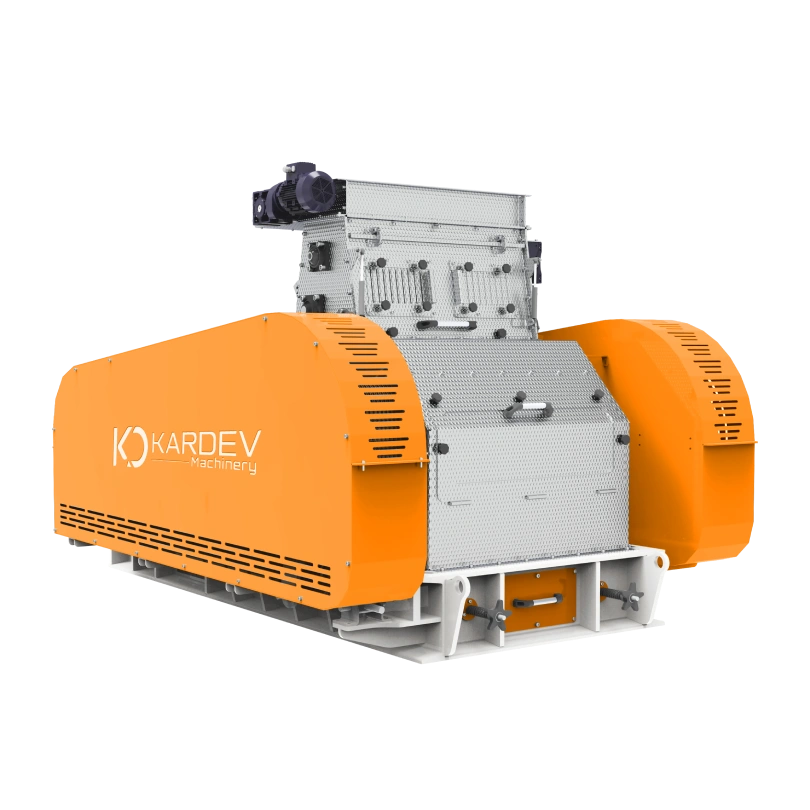
A feed pellet mill compresses conditioned feed between a rotating ring die and rollers. As the material is forced through the holes of the ring die, continuous strands of compressed feed are formed and then cut by adjustable knives to achieve the required pellet length.

Successful pelleting depends on much more than the mechanical design of the pellet mill. Raw material properties, particle size distribution, steam conditioning, die specifications, feeding stability, and cooling performance all have a direct influence on final pellet quality.
Feed pellet mills are widely used in poultry feed, cattle feed, sheep feed, and other compound feed production lines. However, the same pellet mill will not necessarily provide the same capacity or pellet quality with every feed formulation. For this reason, the complete feed production process should be evaluated when selecting and designing a pelleting system.
How Does a Feed Pellet Mill Work?
The pelleting process does not begin by feeding material directly from the hammer mill into the pellet press.
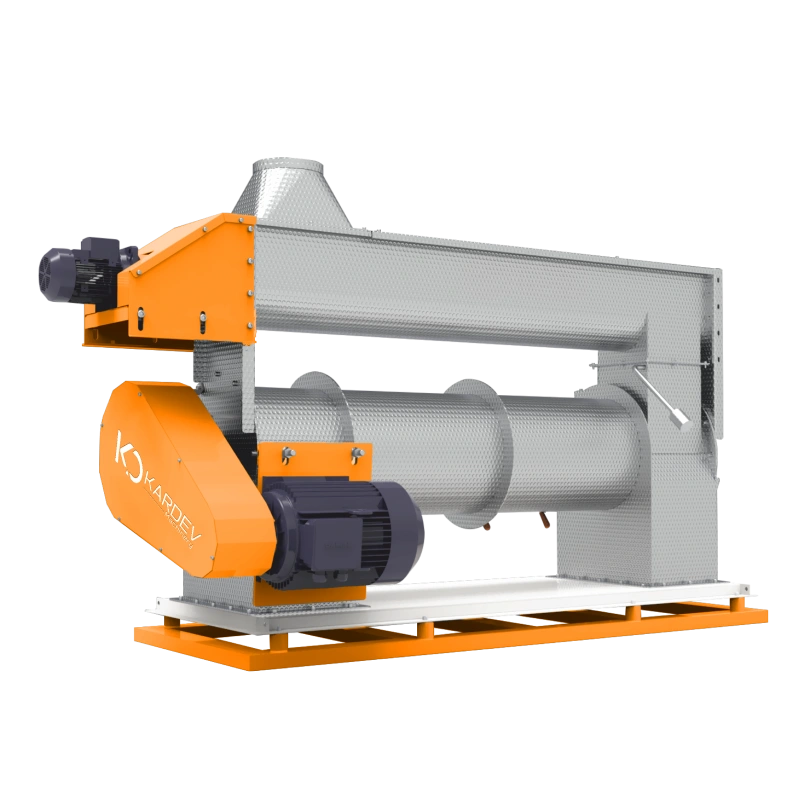
After grinding and mixing, the feed mash is first transferred to a conditioner. Controlled steam is added during conditioning to increase the temperature and moisture of the material and prepare it for efficient pelleting.
The objective of conditioning is not only to heat the feed. Proper conditioning also improves the compressibility of the material and helps create stable conditions before it enters the pellet mill.
The conditioned feed is then transferred through the feeding system into the pelleting chamber, where it reaches the compression zone between the ring die and rollers.
The rollers press the feed against the inner surface of the rotating ring die and force the material through the die holes under high pressure. The continuous feed strands leaving the die are cut by knives to produce pellets of the required length.
After leaving the pellet mill, the hot and moist pellets are transferred to a pellet cooler. Cooling reduces pellet temperature and moisture before the finished product is sent to storage, screening, or packing.
Pellet quality therefore depends on the interaction between several components:
- Feeding system
- Steam supply
- Conditioner
- Feed pellet mill
- Ring die and rollers
- Pellet cooler
When designing a pelleting line, these components should be evaluated as one integrated process rather than as independent machines.
Why Is a Pellet Mill Important in Animal Feed Production?
Pelleting is one of the final processing stages in which the results of the previous feed production operations become visible in the physical quality of the finished product.
Feed ingredients that have already passed through grinding, dosing, mixing, and conditioning reach their final physical form during the pelleting process.
Properly produced feed pellets generally have better physical durability and are less susceptible to breakage and excessive fines during conveying, storage, and handling.
However, good pellet quality cannot be achieved by the pellet press alone.
Problems with particle size distribution, feed formulation, steam quality, conditioning temperature, moisture, feeding stability, or cooling conditions can all affect pellet durability and production performance.
For this reason, replacing the ring die is not always the correct solution when pellet quality decreases. The complete pelleting process should first be evaluated.
At KARDEV, we approach the feed pellet mill as part of an integrated feed production system. Ring die specifications, conditioning capacity, feeding arrangement, raw material characteristics, and upstream grinding conditions are evaluated together during project engineering.
Factors Affecting Feed Pellet Quality
Production capacity is usually one of the first criteria considered when selecting a feed pellet mill. However, capacity alone is not sufficient to determine the correct machine.
Two feed plants requiring the same nominal output may need different pellet mill configurations depending on feed formulation, pellet diameter, raw material characteristics, conditioning conditions, and required pellet quality.
Several important factors influence the performance of a pellet mill and the quality of the finished feed pellets.
Raw Material Characteristics
Different raw materials behave differently during pelleting.
Changes in protein, starch, fiber, fat, and moisture content influence how easily the feed mixture can be compressed through the ring die.
High-fat formulations, for example, can behave very differently from high-starch or high-fiber formulations during pelleting.
Pellet mill operating parameters and ring die specifications should therefore be selected according to the characteristics of the feed formulation.
Grinding and Particle Size Distribution
Before pelleting, the particle size distribution of the ground feed should be properly controlled.
Excessively coarse particles may reduce the uniformity of the pellet structure, while unnecessarily fine grinding can increase energy consumption during the grinding stage.
The objective should not simply be to produce the finest possible particles. Instead, the grinding system should provide a consistent particle size distribution suitable for the required feed formulation and pelleting process.
Conditioning and Steam Quality
Conditioning is one of the most important stages influencing pellet mill performance.
Steam increases the temperature and moisture of the feed mixture and helps prepare the material for compression through the ring die.
For stable pellet production, several parameters should be considered together:
- Steam quality
- Conditioning temperature
- Moisture level
- Retention time
- Feed formulation
- Material flow through the conditioner
The conditioner and pellet mill should therefore be sized and designed as part of the same process.
Ring Die Hole Geometry and Compression Ratio
Ring die selection affects both pellet quality and pellet mill performance.
The diameter of the die holes determines the nominal pellet diameter, but hole diameter alone is not sufficient when selecting a ring die.
The effective working length of the die holes in relation to their diameter influences the level of compression and friction applied to the material as it passes through the die.
An unsuitable die configuration may lead to reduced pellet durability, lower production capacity, excessive power consumption, or unstable pellet mill operation.
For this reason, the ring die should be selected according to:
- Feed formulation
- Required pellet diameter
- Target production capacity
- Raw material characteristics
- Required pellet durability
Roller Adjustment
The rollers are responsible for pressing the conditioned feed against the ring die.
Correct roller adjustment is essential for stable operation, pellet quality, energy efficiency, and wear control.
Improper adjustment can increase wear on both the ring die and rollers and may negatively affect pellet production.
The roller system should also be designed for easy inspection, adjustment, and maintenance.
Pellet Cooling
The pelleting process does not finish when the product leaves the ring die.
Fresh pellets leaving the pellet mill contain relatively high heat and moisture. They must therefore be cooled before storage or packing.
An incorrectly designed cooling process can contribute to pellet cracking, excessive moisture variation, and reduced pellet durability.
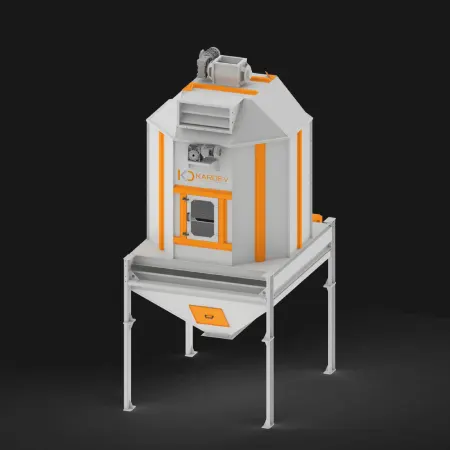
For this reason, the counterflow pellet cooler is an important part of a complete feed pelleting line.
How Is Feed Pellet Mill Capacity Determined?
Feed pellet mill capacity should not be determined only by motor power or ring die diameter.
The same pellet mill may achieve different production capacities depending on the type of feed being produced.
Important factors affecting pellet mill capacity include:
- Feed formulation
- Raw material characteristics
- Particle size
- Pellet diameter
- Ring die specifications
- Conditioning performance
- Steam quality
- Required pellet durability
- Feeding stability
For example, poultry feed and high-fiber cattle feed may not achieve the same production capacity under identical pellet mill conditions.
Therefore, when selecting an animal feed pellet mill, both the required capacity in tons per hour and the types of feed to be produced should be specified.
Ring Die and Roller Selection
The ring die and rollers are among the most important wear components of a feed pellet mill.
The correct ring die configuration depends on the feed formulation, required pellet diameter, desired pellet durability, and production conditions.
Using an unsuitable die can increase energy consumption, reduce capacity, or create unnecessary operating problems.
Roller condition and adjustment should also be monitored regularly. Proper maintenance of the die and roller system contributes to stable production and helps reduce operating costs over the long term.
Before replacing a ring die because of poor pellet quality, it is advisable to check the complete process, including:
- Grinding quality
- Particle size distribution
- Steam supply
- Conditioner performance
- Feeding stability
- Roller adjustment
- Cooling conditions
This approach helps identify the actual source of the problem rather than focusing on a single machine component.
KARDEV Feed Pellet Mill Solutions
Every animal feed production plant has different requirements depending on its production capacity, feed formulations, raw materials, plant layout, and operating conditions.
For this reason, KARDEV does not approach feed pellet mill selection as a standard machine-only decision.
When engineering a feed pellet mill system, we evaluate:
- Required production capacity
- Types of animal feed to be produced
- Raw material characteristics
- Target pellet diameter
- Ring die configuration
- Conditioning requirements
- Steam system
- Feeding arrangement
- Upstream grinding process
- Pellet cooling system
- Plant layout and downstream equipment
This process-based approach allows the pellet mill to be integrated correctly into the complete animal feed production line.
KARDEV provides feed pellet mill solutions for poultry feed, cattle feed, sheep feed, and different compound feed applications.
Looking for a Feed Pellet Mill for Your Project?
If you are planning a new feed mill or upgrading an existing pelleting line, share your required capacity, feed formulations, target pellet size, and plant information with our engineering team.
KARDEV can evaluate the complete process and recommend a feed pellet mill configuration suitable for your production requirements.
Frequently Asked Questions
What is a feed pellet mill?
A feed pellet mill is a machine used to compress conditioned feed mash through a die to produce uniform animal feed pellets. Industrial feed pellet mills commonly use a ring die and roller system for continuous pellet production.
What is the difference between a pellet mill and a pellet press?
In animal feed production, the terms pellet mill and pellet press are often used to describe the same type of pelleting machine. “Feed pellet mill” is particularly common when referring to industrial animal feed production equipment.
What types of feed can be produced with a pellet mill?
Feed pellet mills can be used for poultry feed, cattle feed, sheep feed, and various compound feed formulations. Ring die specifications and operating parameters should be selected according to the type of feed being produced.
Why is steam used in a feed pellet mill?
Steam is added during the conditioning stage to control feed temperature and moisture and prepare the material for pelleting. Proper conditioning can improve material flow through the die and contribute to stable pellet production.
What determines feed pellet mill capacity?
Pellet mill capacity depends on several factors, including feed formulation, raw material characteristics, particle size, pellet diameter, ring die specifications, conditioning performance, and required pellet quality. Capacity should therefore be evaluated according to the actual production conditions rather than machine size alone.
How do I choose the right feed pellet mill?
The selection of a feed pellet mill should consider required capacity, feed formulation, pellet diameter, ring die specifications, motor power, conditioning system, maintenance requirements, spare parts availability, and integration with the complete feed production line.
How often should a feed pellet mill be maintained?
Maintenance intervals depend on operating hours, production intensity, feed formulation, and raw material characteristics. Ring dies, rollers, bearings, lubrication points, and other moving components should be inspected regularly and worn parts should be replaced according to operating conditions and manufacturer recommendations.
Can KARDEV manufacture pellet mills for specific feed production projects?
Yes. KARDEV evaluates production capacity, feed formulation, required pellet characteristics, conditioning requirements, and plant layout to provide feed pellet mill solutions designed for specific animal feed production projects.
OTHER PRODUCTS
Quality is never a coincidence.