Drum Sieve
A drum sieve is used in feed mills for the coarse pre-cleaning of incoming raw materials. Before corn, barley, wheat and other grains are transferred to storage or the production line, oversized foreign materials should be separated from the product.
In the KARDEV drum sieve, the raw material enters a rotating cylindrical screen. As the drum rotates, the product comes into contact with the perforated screen surface. Material that can pass through the screen openings falls into the lower section, while oversized impurities continue through the drum and are discharged separately.

The screen opening size is selected according to the raw material and the type of impurities to be removed. If the openings are too small, good product may have difficulty passing through the screen. If they are too large, some unwanted materials may pass through together with the product.
What Is a Drum Sieve and Where Is It Used?
A drum sieve is a rotary screening machine used for the coarse pre-cleaning of raw materials before they enter the production process.
It is also known as a rotary drum sieve or, depending on the application, a drum pre-cleaner.
In KARDEV feed mill projects, the drum sieve is generally positioned in the raw material intake section. Grain unloaded from trucks can be screened before being transferred to storage silos or further processing equipment.
Removing coarse foreign materials at this stage helps prevent them from reaching downstream equipment. Corn cobs, strings, plastic pieces, paper, lumps and similar materials can interfere with product flow or cause problems in conveying and grinding equipment.
When positioning the drum sieve, the equipment installed after the intake section is also considered. The objective is generally to remove oversized impurities before they reach bucket elevators, conveyors, hammer mills or other process machinery.
How Does a Drum Sieve Work?
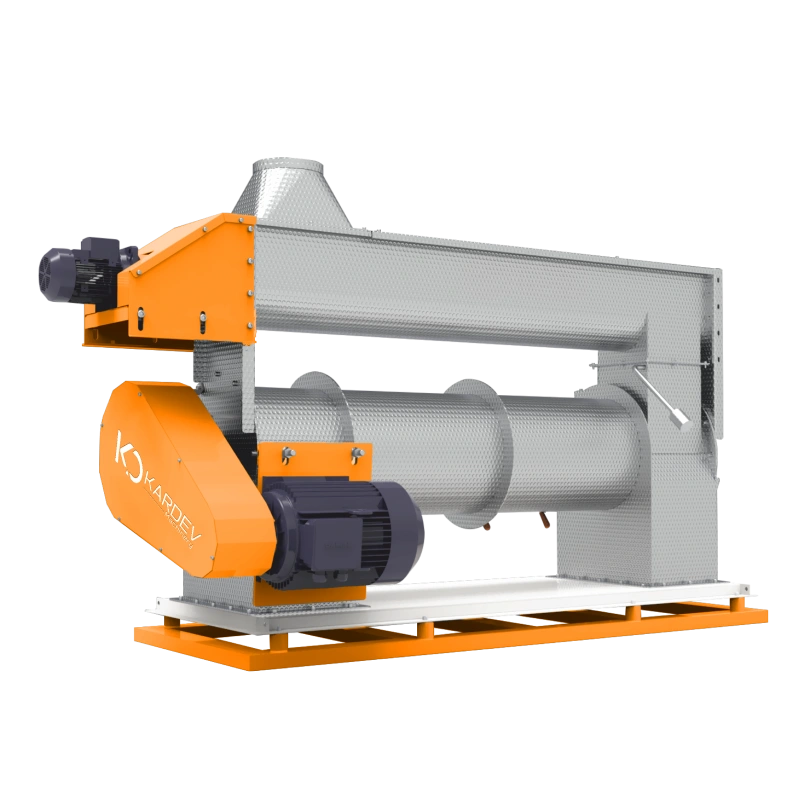
Raw material entering the drum sieve is directed into a rotating cylindrical screen driven by a geared motor.
As the drum rotates, the material moves along the screening surface. Grain and other acceptable material smaller than the selected screen opening pass through the perforations and continue to the production line.
Oversized material remains inside the drum. Internal spiral flights move these impurities towards the waste outlet.
KARDEV drum sieves use a brush cleaning system to help keep the screen surface open during operation. As the drum rotates, the brushes contact the screening surface and help remove particles that may become lodged in the openings.
How Is the Screen Hole Size Selected?
The screen opening is selected according to the raw material and the foreign materials that need to be separated.
Corn, barley and wheat do not always require the same screen configuration. Grain size and shape should therefore be considered when selecting the perforation size.
Selection is not based only on the average grain size. Corn cobs, lumps, straw and other oversized impurities present in the incoming material should also be evaluated.
Depending on the application, more than one screening section can be used. Different opening sizes can be installed in successive sections to provide staged separation.
Smaller Screen Openings
If the screen openings are too small, part of the acceptable product may not pass through easily. More material can remain inside the drum, which may reduce effective capacity.
Larger Screen Openings
If the openings are too large, some impurities that should be removed may pass through the screen together with the clean product.
How Is Drum Sieve Capacity Determined?
Drum sieve capacity is primarily determined according to the hourly flow rate of the raw material intake line.
KARDEV drum sieves are available in different configurations for capacities ranging from approximately 10 to 200 tons per hour, depending on the raw material, screen configuration and project requirements.
Screen opening size also affects throughput. The drum diameter and length are selected according to the required capacity and the screening area needed for the product.
As throughput increases, sufficient screen surface must remain available for effective separation. Excessive loading inside the drum can reduce screening efficiency and may carry acceptable grain towards the waste outlet.
The feeding equipment before the drum sieve should also be considered. If an elevator or conveyor delivers material irregularly or in sudden surges, the drum can be temporarily overloaded.
For this reason, drum sieve capacity should be selected together with the capacity and operating characteristics of the upstream conveying system.
Factors Affecting Screening Performance
Efficient screening requires sufficient contact between the product and the screening surface.
Several factors can affect drum sieve performance.
Product Feeding
Raw material should enter the drum at a reasonably consistent flow rate.
When a large amount of material enters in a short period, accumulation may occur in one section of the drum. Some grain may not reach the screen surface effectively and can move towards the waste outlet together with oversized impurities.
Open Screen Area
Grain particles, straw and other materials can become lodged in the screen openings and reduce the effective open area.
Brushes used in KARDEV drum sieves help clean these openings during operation. Brush wear and contact with the screen surface should therefore be checked periodically.
Raw Material Condition
The condition of the incoming raw material also affects screening behaviour.
Wet material or raw material containing a high proportion of fines does not behave in the same way as dry, clean grain. Higher moisture levels may cause particles to stick together or adhere to the screen surface.
Regular inspection of the screen becomes particularly important under these conditions.
Drum Rotation
Drum movement influences how the product travels through the machine and how long it remains in contact with the screen.
Drum speed should therefore be considered together with throughput, screening performance and the amount of acceptable product reaching the waste outlet.
Amount of Foreign Material
When the proportion of foreign material increases, the load at the waste outlet also increases.
Incoming raw material condition and waste discharge should therefore be evaluated together when screening performance changes.
Drum Sieve vs. Vibrating Sieve
Drum sieves and vibrating sieves can both be used in the same feed mill, but they generally perform different functions.
Drum Sieve
A drum sieve separates material through the rotation of a cylindrical screening body.
It is primarily used at the raw material intake stage to remove coarse foreign materials before grain enters storage or downstream processing equipment.
Vibrating Sieve
A vibrating sieve uses vibration to move and separate material across a screening surface.
In KARDEV feed mill projects, vibrating sieves can be used at different process points, including the separation of fines from finished pellets after pelleting.
The two machines therefore normally have different positions and functions within the production line.
Which Raw Materials Can Be Processed?
Drum sieves can be used for the coarse cleaning of corn, barley, wheat and other grains or granular raw materials.
The screen configuration and opening size are selected according to the particle size of the raw material and the impurities that need to be separated.
Which Foreign Materials Can a Drum Sieve Remove?
Depending on the selected screen openings, a drum sieve can separate coarse foreign materials such as:
- corn cobs
- strings
- plastic and nylon pieces
- paper
- straw
- large lumps
- other oversized impurities
The size and nature of the impurities should be considered when selecting the screening configuration.
Removing these materials at the intake stage helps prevent them from reaching downstream equipment.
Drum Sieve Maintenance
Regular inspection should include the screen surface, brushes, drive system, bearings and product discharge points.
Blocked screen openings should be cleaned, and brush contact with the screening surface should be checked.
The drum rotation and waste outlet should also be monitored. Unusual noise, vibration or resistance during rotation may indicate that the bearings or drive system require inspection.
If material accumulates at the waste outlet, the discharge path should first be checked to confirm that separated material can leave the machine freely.
OTHER PRODUCTS
Quality is never a coincidence.