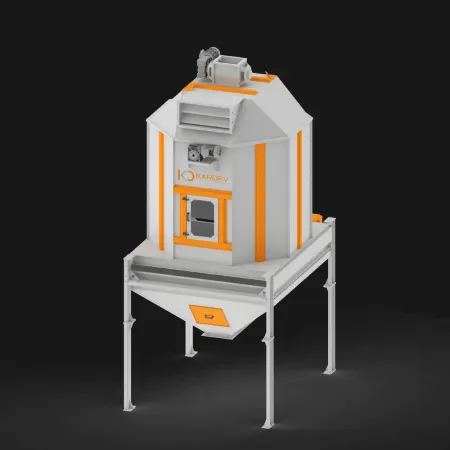
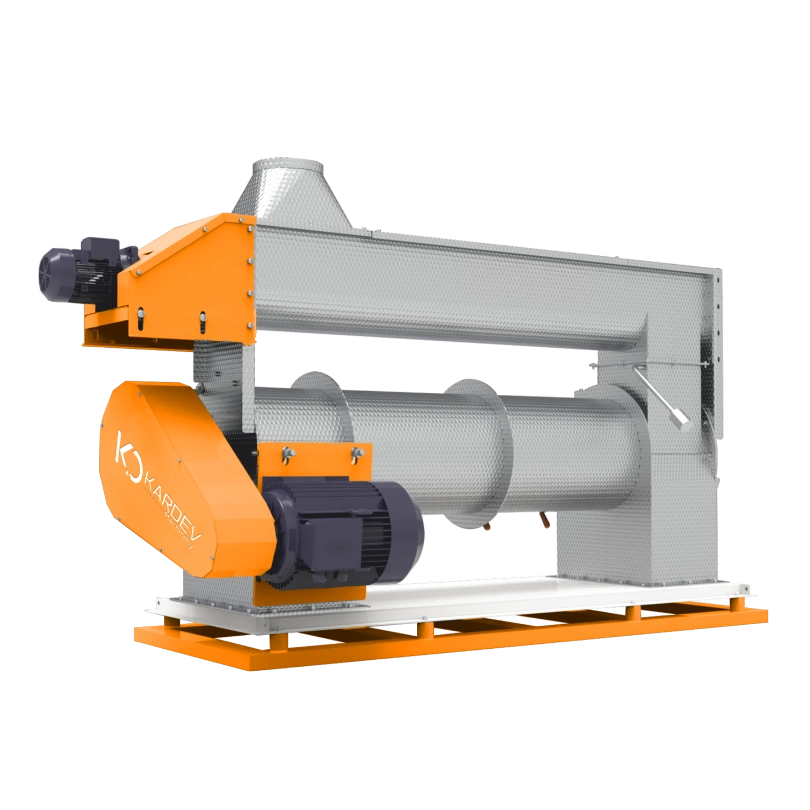
Dust Cyclone
A dust cyclone is industrial equipment used to separate dust particles from airflow in pellet cooling, grinding, and aspiration systems in feed mills. It operates through centrifugal force, allowing dust carried by the air to be collected and, where suitable, recovered for reuse in the production process.
KARDEV Machinery manufactures dust cyclones according to the airflow requirements, connection dimensions, and operating conditions of each plant. The cyclones are equipped with maintenance access doors, while body materials, inlet and outlet adapters, and mounting configurations can be customized to suit project requirements.

What Is a Dust Cyclone and What Is It Used For?
A dust cyclone, also known as a cyclone separator, is a mechanical separation device used to remove solid particles from an air stream.
In feed production plants, cyclones are commonly used in pellet cooler aspiration systems, grinding lines, and other dust extraction applications.
Dust separated inside the cyclone is discharged through the bottom outlet. In KARDEV cyclone systems, a rotary airlock allows collected material to be discharged while limiting unwanted air entry through the bottom opening.
Depending on the process design and material suitability, the collected dust may be returned to the production system or transferred to a separate collection point.
Cyclones do not separate all particle sizes with equal efficiency. Larger and denser particles are generally easier to collect, while some fine dust may remain suspended in the outgoing air.
For applications requiring higher dust collection efficiency, a cyclone can be combined with a suitable filtration system, such as a pulse jet filter.
How Does a Dust Cyclone Work?
Dust-laden air enters the cyclone through an inlet connected to the aspiration system. Inside the cylindrical body, the air follows a rotating, downward-flowing path.
As the airflow rotates, centrifugal effects push dust particles toward the outer wall of the cyclone.
Particles reaching the wall move downward along the cylindrical and conical sections and accumulate near the bottom outlet.
Meanwhile, much of the air changes direction near the center of the cyclone and flows upward toward the top outlet.
The separation performance depends on several factors, including airflow rate, inlet velocity, particle size, dust density, and cyclone geometry.
Dust-Laden Air Inlet
Dust-laden air from a pellet cooler or grinding system reaches the cyclone through an air duct.
Sharp bends, sudden reductions in duct cross-section, or unsuitable inlet connections may disturb the airflow entering the cyclone.
Therefore, inlet duct dimensions and connection geometry must be considered during system design.
KARDEV manufactures cyclone inlet adapters according to the duct dimensions and installation requirements of new or existing feed plants.
Dust Separation by Centrifugal Force
The rotating airflow inside the cyclone causes dust particles to move toward the outer wall.
Larger and denser particles are generally separated more easily, while smaller or lighter particles may remain entrained in the airflow and reach the upper outlet.
Separation efficiency is not determined by particle characteristics alone. Air velocity, cyclone diameter, cone geometry, and outlet dimensions also influence dust collection performance and pressure drop.
Dust Discharge Through the Rotary Airlock
Dust collected at the bottom of the cyclone is discharged through a rotary airlock.
The airlock provides controlled material discharge while limiting unwanted air entering through the bottom outlet.
Improper airlock operation or leakage around its connections may disturb the airflow inside the cyclone and reduce separation performance.
Where Are Dust Cyclones Used in Feed Mills?
Dust cyclones are used in different sections of feed production plants, including pellet cooling, grinding, and aspiration systems.
Their location and configuration depend on the process requirements, airflow conditions, and characteristics of the material being separated.
Pellet Cooler Cyclone
In pellet cooling systems, air passes through the hot pellets to reduce their temperature.
The aspiration fan extracts this air, which may carry pellet dust and small particles.
A pellet cooler cyclone separates part of the dust from the extracted air. The collected material moves toward the bottom outlet and is discharged through the rotary airlock.
KARDEV cyclone systems for pellet cooling applications are designed according to the cooler’s airflow requirements, fan operating conditions, and expected dust load.
Changes in aspiration airflow may also affect cyclone operation. Therefore, the fan and cyclone must be selected as compatible components of the cooling system.
Grinding and Hammer Mill Aspiration Systems
Aspiration systems may be used together with hammer mills and other grinding equipment in feed production plants.
Fine particles generated during grinding can be carried by the airflow. Depending on the process configuration, a cyclone may be installed to separate part of this material.
Dust from grinding systems may have different particle size and density characteristics compared with dust generated during pellet cooling.
For this reason, the same cyclone dimensions should not automatically be assumed suitable for both applications.
Raw Material Cleaning and Aspiration Systems
Cyclones can also be used to separate dust carried by aspiration systems in grain cleaning and raw material preparation sections.
In corn and barley processing lines, a fan and cyclone arrangement may be selected according to the type of cleaning equipment and the required airflow.
Cyclone positioning, duct connections, and operating conditions are evaluated together with the associated processing equipment.
Structural and Technical Features of KARDEV Dust Cyclones
KARDEV dust cyclones can be manufactured in different dimensions and material configurations according to the air handling requirements and layout of the production facility.
Cyclone Body Design
The upper section of the cyclone has a cylindrical structure, while the lower section is conical.
The cylindrical section supports the rotating airflow, while the cone guides separated dust toward the bottom discharge outlet.
Cyclone diameter, body height, cone angle, and upper outlet dimensions affect airflow behavior and separation performance.
In applications involving moist or sticky dust, material may accumulate in the lower cone. Dust characteristics and discharge conditions should therefore be considered during the design process.
Body Material Options
KARDEV dust cyclones can be manufactured using different materials according to project requirements:
- Carbon steel sheet
- Galvanized steel sheet
- AISI 304 stainless steel
- AISI 316 stainless steel
Material selection depends on the characteristics of the processed product, moisture conditions, corrosion exposure, cleaning requirements, and installation environment.
Air Inlet and Outlet Adapters
Cyclone inlet and outlet connections can be manufactured according to the existing or planned air duct dimensions.
When installing a cyclone in an existing feed mill, duct orientation and connection dimensions may differ from standard configurations.
KARDEV can manufacture custom inlet and outlet adapters to suit these installation requirements.
Bottom Discharge and Rotary Airlock
The rotary airlock installed at the bottom outlet allows separated dust to be discharged in a controlled manner.
It also limits air leakage through the discharge opening and helps maintain the airflow conditions inside the cyclone.
The discharge capacity of the rotary airlock should match the expected quantity of collected material.
Maintenance Access Doors
KARDEV dust cyclones are equipped with maintenance access doors.
These openings allow operators to inspect dust accumulation, perform cleaning operations, and examine internal surfaces.
Access door positions are considered together with the plant layout and maintenance accessibility.
Support Legs and Platform Installation
The supporting structure of KARDEV cyclones can be adapted to project requirements.
Depending on the design, cyclones may be installed on support legs or mounted directly onto a suitable structural platform.
Installation planning must account for air duct connections, the rotary airlock discharge system, and sufficient maintenance access.
Cyclone Air Inlet and Outlet Connections
The dust-laden air duct is connected to the cyclone inlet. The upper outlet is connected to the fan or subsequent air duct, depending on the system arrangement.
Air leakage at duct joints or connection points may affect the operating conditions of the system.
In negative-pressure applications, unwanted air can enter through poorly sealed connections.
Therefore, duct joints, adapters, access door seals, and connection points should be inspected.
KARDEV cyclone connection dimensions can be adapted to the existing duct arrangement of the feed mill.
How Is Dust Cyclone Capacity Determined?
Cyclone capacity cannot be determined solely from the hourly feed production capacity of the plant.
One of the main design parameters is the volumetric airflow passing through the cyclone, generally expressed in m³/h.
The following parameters are considered during cyclone selection and sizing:
- Required airflow capacity (m³/h)
- Air velocity at the cyclone inlet
- Dust concentration and loading
- Particle size and density
- Air temperature and moisture conditions
- Required separation performance
- Cyclone pressure drop
- Fan operating point and performance curve
- Rotary airlock discharge capacity
For example, replacing the aspiration fan of a pellet cooler may change the airflow passing through the cyclone.
In this case, the operation of the existing cyclone must be evaluated under the new airflow conditions.
Two systems with the same airflow rate may carry different quantities of dust. Therefore, the expected amount of collected material and the required rotary airlock capacity should also be considered.
Air Velocity and Particle Size
Air velocity at the cyclone inlet is an important factor affecting particle separation.
Insufficient inlet velocity may reduce the separation efficiency of fine particles.
However, excessively high velocity can increase pressure drop, wear, and, under certain operating conditions, particle re-entrainment.
For this reason, inlet velocity must be evaluated together with cyclone geometry and dust characteristics.
Dust Density and Cyclone Geometry
Particles of similar size but different densities may behave differently inside the cyclone.
Denser particles generally move toward the cyclone wall more easily, while lighter particles may remain suspended in the airflow.
Cyclone diameter, cylindrical section height, cone geometry, and upper outlet dimensions also influence the rotating airflow.
Consequently, two cyclones operating at the same airflow rate may have different separation efficiencies and pressure losses.
Pressure Drop and Fan Performance in Cyclone Systems
As air travels from the cyclone inlet to the upper outlet, it encounters flow resistance.
This resistance creates a pressure drop across the cyclone.
The aspiration fan must be selected to overcome this pressure drop together with the resistance of the remaining ductwork and equipment.
If cyclone pressure loss is not included in the fan calculation, the system may fail to achieve the required airflow rate.
For example, adding a cyclone to an existing pellet cooling aspiration line may increase the total system resistance.
Even if the fan continues operating at the same rotational speed, the delivered airflow may decrease.
For this reason, the fan performance curve should be checked and the new operating point evaluated.
Pressure measurements taken at suitable locations before and after the cyclone can help assess its operating conditions.
Integration with Aspiration and Filtration Systems
Dust cyclones can operate independently in suitable applications or be installed before filtration equipment, such as pulse jet filters.
When used as a pre-separator, the cyclone removes part of the larger and denser dust particles before the airflow reaches the filter.
This arrangement can reduce the dust load reaching the filter elements.
Finer particles remaining in the airflow may then be collected by the downstream filtration system.
Not every aspiration line requires both a cyclone and a filter. The appropriate configuration depends on dust characteristics, process requirements, and applicable emission limits.
When a cyclone and filter are installed together, their combined pressure losses, duct resistance, and fan performance must be evaluated.
Adding a filter to an existing system may increase total resistance and reduce airflow if the fan is not suitable for the new operating conditions.
How to Maintain and Clean a Dust Cyclone
Dust cyclone maintenance includes inspecting the inlet and outlet connections, internal body surfaces, maintenance access doors, and bottom discharge equipment.
Dust accumulation may develop around the inlet or in the lower conical section over time.
KARDEV cyclone access doors allow internal inspections and cleaning when required.
The following points should be checked during maintenance:
- Dust accumulation in inlet and outlet ducts
- Wear on internal body surfaces
- Blockages in the lower cone
- Rotary airlock operation
- Sealing of maintenance doors and gaskets
- Air leakage around duct connections
If the rotary airlock is operating but no material is discharged, a blockage may be present in the lower cone.
Before maintenance or cleaning, the fan, rotary airlock, and related equipment must be stopped safely. Energy sources must be isolated and secured against unexpected start-up.
Because feed dust may create a combustible dust atmosphere, all maintenance and cleaning operations must follow the facility’s dust explosion prevention and occupational safety procedures.
What Should Be Considered When Selecting a Dust Cyclone?
The first step in cyclone selection is identifying the production process in which the equipment will operate.
Pellet cooler aspiration, grinding systems, and raw material cleaning lines may have different airflow requirements and dust characteristics.
For this reason, cyclone selection should not be based only on body diameter or physical dimensions.
Airflow capacity, particle characteristics, required separation efficiency, and available fan pressure must be evaluated together.
Installation space is also important, particularly in existing feed mills.
Adequate clearance must be provided for inlet and outlet connections, rotary airlock discharge, and maintenance access doors.
Insufficient installation space or unsuitable duct connections may create operational and maintenance difficulties.
KARDEV Machinery provides dust cyclone solutions for pellet cooling, grinding, and aspiration systems in feed production plants.
Contact KARDEV Machinery for information about cyclone dimensions, material options, custom connection configurations, and technical quotations suitable for your project.
OTHER PRODUCTS
Quality is never a coincidence.