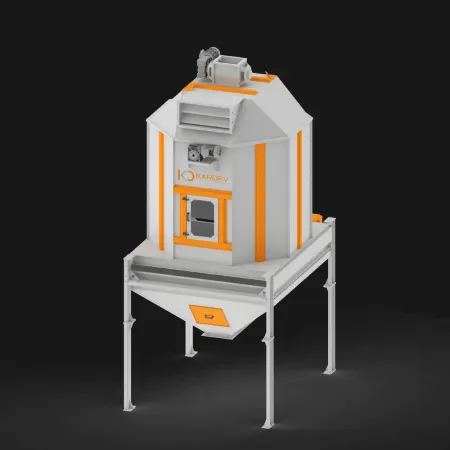
Flake Dryer Cooler
Flakes leaving the flaking mill are hot and contain moisture. Before storage, excess moisture must be removed and the product temperature reduced. This process is carried out in a flake dryer cooler.
In the KARDEV flake dryer cooler, the product is dried with heated air on the upper levels. On the bottom level, ambient air is used to reduce the temperature of the flakes. The processed product is then transferred to the storage or packaging line.

What Is a Flake Dryer Cooler Used For?
Hot flakes with excess moisture should not be transferred directly to storage or packaging. The dryer cooler first reduces the moisture content of the product and then lowers its temperature.
In the drying sections, heated air passes through the flake layer to remove moisture. When the product reaches the bottom level, it is cooled using ambient air. The discharged flakes are brought to suitable moisture and temperature conditions for storage or further handling.
If the product leaves the dryer with excessive moisture, storage problems may occur. The discharge temperature is also important. If the flakes remain too hot, the airflow and product residence time inside the machine should be checked.
How Does a Flake Dryer Cooler Work?
Flakes discharged from the flaking mill enter the upper section of the dryer cooler. Heated air supplied through a heat exchanger passes through the product resting on perforated trays, initiating the drying process. As the flakes move through successive levels, their moisture content gradually decreases.
At the bottom level, heated air is no longer used. Instead, ambient air passes through the product to reduce its temperature. The flakes are dried on the upper levels and cooled on the final level.
A paddle chain conveyor system moves the product through the different levels. Fine particles carried by the airflow are separated in a cyclone and returned to the production line. A jet pulse cleaning system removes accumulated fine material from the perforated tray surfaces.
The residence time of the product directly affects the final moisture content. If the discharge moisture is too high, the product conveying speed and airflow rate should be checked.
Drying and Cooling Stages
Inside the flake dryer cooler, the product moves progressively from the upper levels toward the bottom. Heated air from the heat exchanger passes through the flake layer and removes moisture. The product continues to dry as it travels through each stage.
On the lowest level, ambient air is used instead of heated air. The main purpose of this section is to reduce the product temperature rather than perform additional drying. The cooled flakes are then transferred to storage or packaging.
Drying performance on the upper levels also affects the final cooling stage. If the flakes reach the cooling section with excessive moisture, the airflow and product movement through the drying levels should also be examined.
Perforated Tray System
Flakes travel across perforated trays while heated air passes through the product layer. When fine particles accumulate in the perforations, airflow becomes restricted. This can reduce drying efficiency in certain areas and cause variations in the final moisture content.
The jet pulse system used in KARDEV dryer coolers helps remove accumulated fine material from the perforated surfaces.
Product distribution across the trays also affects drying performance. If a thick layer of flakes forms in one area, airflow resistance increases in that section. Therefore, both airflow and product distribution should be considered during operation.
If moisture levels vary across the discharge, operators should check not only the heated air settings but also the condition of the perforations and the distribution of the product across the trays.
Aspiration and Cyclone System
During drying and cooling, some fine flake particles may become entrained in the exhaust airflow. The aspiration system carries this air to the cyclone separator.
Inside the cyclone, the air follows a rotating path. Heavier particles move toward the outer wall and fall to the bottom of the separator. The recovered material is returned to the production line, while the separated air exits the cyclone.
In the KARDEV flake dryer cooler system, fine product collected by the cyclone is returned to the process.
If excessive product carryover is observed at the cyclone outlet, the airflow rate and cyclone operation should be checked. Excessive aspiration can increase the amount of fine material carried into the air handling system.
Why Are Drying and Cooling Necessary in Flake Production?
Storing flakes while they are still hot and contain excess moisture can cause temperature buildup and moisture-related storage problems.
The drying section removes excess moisture, while the cooling section reduces the product temperature before storage or packaging.
Drying conditions should be adjusted according to the required discharge properties. Excessive moisture removal can leave the flakes unnecessarily dry. For this reason, both moisture content and temperature should be monitored at the dryer cooler outlet.
In KARDEV grain flaking lines, drying is performed first, followed by cooling as the final stage. Once the product reaches the required conditions, it is transferred to storage or packaging.
What Determines Flake Dryer Cooler Capacity?
When selecting a flake dryer cooler, the hourly production rate of the flaking mill is a primary consideration. For example, if the flaking mill produces 5 tons of flakes per hour, the dryer cooler must be capable of handling the same throughput.
Production Line Capacity
The hourly output of the flaking mill is the starting point for equipment selection. KARDEV offers grain flaking lines with production capacities of 5 and 10 tons per hour. The dryer cooler is selected according to the required line capacity.
Product Inlet Moisture
The moisture content of the flakes entering the dryer directly affects the drying load. Higher inlet moisture means that more water must be removed from the product.
Drying Time
The time the product spends inside the drying levels directly influences the final moisture content. If the flakes move through the machine too quickly, they may reach the outlet before sufficient moisture has been removed.
Airflow
As production capacity increases, the quantity of product passing through the drying levels also increases. Insufficient airflow can result in higher discharge moisture.
When the flaking mill throughput increases, the dryer cooler discharge conditions should also be monitored. If the final moisture content begins to rise, the product conveying speed and airflow should be checked.
A flaking mill operating at its rated capacity does not automatically mean that the dryer cooler can achieve the required drying performance at the same throughput.
Technical Features of the Flake Dryer Cooler
The KARDEV flake dryer cooler combines drying and cooling within a single machine. As the product moves from the upper levels toward the bottom, the system operates with the following components:
- Steam-heated air system: Air is heated through a steam-operated heat exchanger in the upper drying sections.
- Perforated trays and paddle chain conveyor: The product moves through the machine on perforated trays using a paddle chain conveying system.
- Ambient air cooling: The bottom level uses ambient air to reduce the temperature of the flakes.
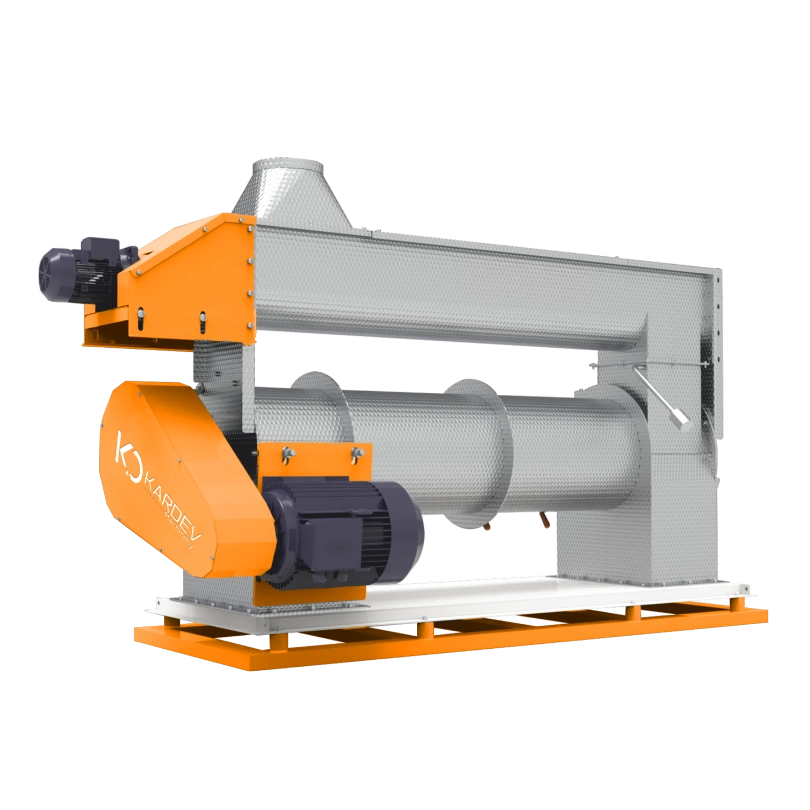
- Cyclone separator: Fine product particles carried by the airflow are separated and returned to the production line.
- Jet pulse cleaning system: Accumulated fine material is removed from the perforated tray surfaces.
- Material options: The machine body can be manufactured from S235JR carbon steel, galvanized steel sheet or AISI 304 stainless steel upon request.
Application in Grain Flaking Production Lines
The flake dryer cooler is installed downstream of the flaking mill.
After leaving the steam conditioning tower, the grain passes through the flaking mill and then enters the dryer cooler. This equipment arrangement completes the process from steam conditioning and flaking to preparing the finished product for storage.
When the hourly production rate of the flaking mill increases, the dryer cooler must also be capable of processing the same product quantity. Otherwise, material may accumulate between the flaking mill and the drying and cooling equipment.
After drying and cooling, the finished flakes can be transferred to a finished product silo, packaging line or dispatch section.
What Should Be Considered When Selecting a Flake Dryer Cooler?
When choosing a flake dryer cooler, it is important to consider not only the production capacity of the flaking mill but also the moisture content and temperature of the incoming product.
Production Capacity
The dryer cooler must be capable of handling the hourly output of the flaking mill. KARDEV offers grain flaking lines with capacities of 5 and 10 tons per hour. Higher production rates increase the product load on the drying and cooling equipment.
Drying Surface Area
The available drying surface must be sufficient to provide effective contact between the heated air and the product. The number of levels and the perforated tray surface area also influence the residence time of the flakes inside the machine.
Airflow Rate
The fan airflow capacity should be selected according to the quantity of product being processed. If airflow is insufficient at higher production rates, drying performance may decrease and the flakes may leave the machine with excessive moisture.
Perforated Trays and Cleaning System
As fine particles accumulate on the tray surfaces, airflow through the perforations becomes restricted. Increasing buildup can create uneven drying conditions.
In KARDEV dryer coolers, the jet pulse cleaning system helps remove these deposits from the perforated surfaces.
Aspiration and Cyclone
Fine product particles carried by the airflow should be recovered whenever possible. The cyclone separates entrained particles from the air and returns the recovered material to the production line.
For more information about flake dryer cooler selection, capacity requirements and integration into a complete grain flaking line, contact KARDEV. Our technical team can help you plan a drying and cooling solution suitable for your production facility.
OTHER PRODUCTS
Quality is never a coincidence.