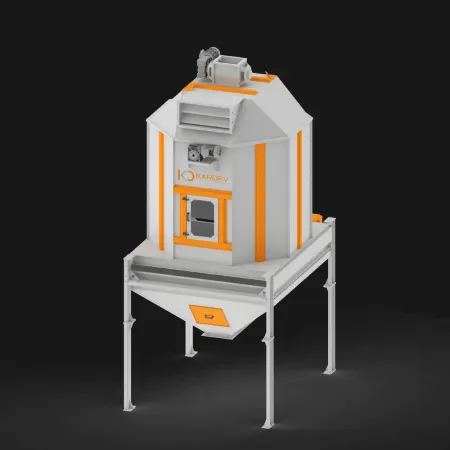
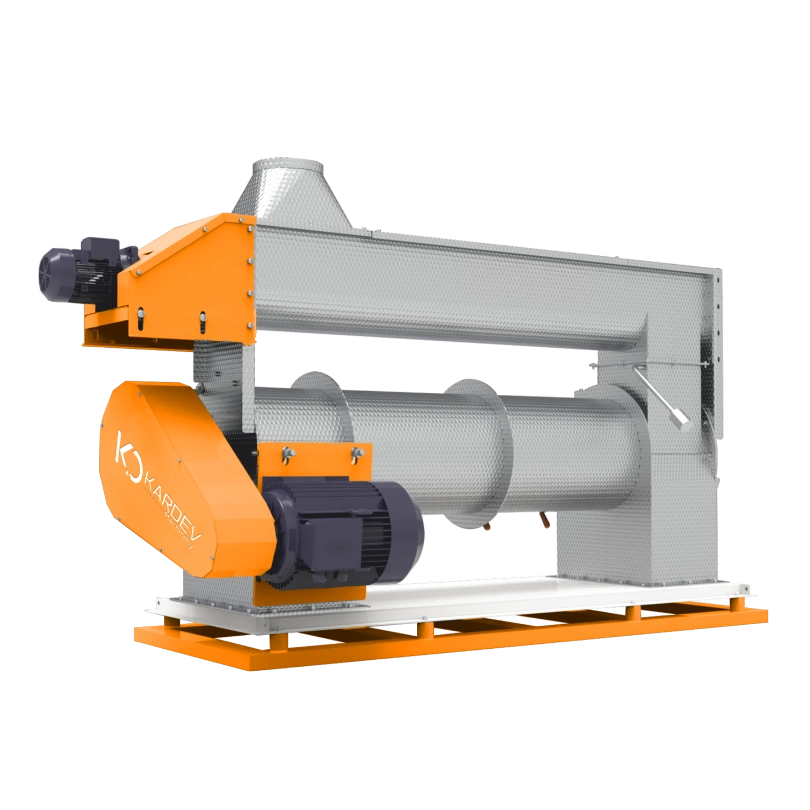
Roller Mill
A roller mill reduces the particle size of grains and similar raw materials by passing them between rotating rolls. The material is compressed between the rolls and broken into smaller particles.
In KARDEV roller mills, the rolls rotate toward each other. The gap between them can be adjusted to produce coarser or finer particles. Single, double and triple-deck models allow the material to pass through one or more grinding stages.

As the roll gap decreases, the resulting particle size generally becomes smaller. However, an excessively narrow gap may also reduce throughput. The correct setting is determined by evaluating both the particle size of the discharged material and the required hourly capacity.
What Is a Roller Mill Used For?
A roller mill is used to control the particle size of raw materials in animal feed production. Corn, barley and other grains can be processed to achieve the particle size required by the feed formulation.
Not every raw material needs to be finely ground. Some feed formulations require a coarser particle structure. By adjusting the roll gap, the mill can produce material with the desired characteristics.
Compared with hammer mills, roller mills may generate fewer fine particles and less dust under suitable operating conditions. They can also provide a more consistent particle size distribution, particularly when processing cereal grains.
How Does a Roller Mill Work?
Raw material is first delivered to the rolls through the feeding system. It passes between two rolls rotating toward each other, where it is compressed and broken into smaller particles. Depending on the roll surface profile and operating speeds, cutting and shearing effects may also contribute to particle size reduction.
In double and triple-deck roller mills, the first grinding stage generally produces a coarser material. The product then passes through subsequent stages, where the roll gaps can be set progressively narrower to achieve the required particle size.
Each grinding stage can be adjusted independently according to the desired result.
If the material leaving the first stage is too coarse, the corresponding roll gap should be checked. If excessive fines are generated in a lower stage, the gap may be too narrow. The settings of each roll pair should therefore be evaluated separately.
- Roll Gap Adjustment and Particle Size
The distance between the rolls directly affects the particle size of the discharged material.
Different raw materials may produce different particle sizes even when the same roll gap is used. For this reason, the setting should be adjusted according to the characteristics of the material being processed.
The roll surface profile, including the configuration of grooves and teeth, also influences the grinding result.
In KARDEV roller mills, the roll gap is adjusted using geared motors. The gap position can be monitored through the automation system.
A sampling compartment allows operators to inspect the discharged material during production.
If the sample contains particles larger than required, the roll gap can be gradually reduced. If the product is excessively fine, the gap can be increased. Motor load and production capacity should also be considered during adjustment.
When the raw material changes, the roll settings may need to be revised.
- Feeding System
The feeding system delivers raw material to the roll inlet and helps distribute it evenly across the roll width.
Uniform feeding is important for balanced operation. If material accumulates on one side, that section of the rolls carries a greater load while the remaining surface is underutilized.
KARDEV roller mills use a rotary feeder to deliver material continuously and distribute it across the roll inlet.
If differences in particle size are observed across the discharged product, the feeding system should also be checked. Uneven feeding can affect grinding consistency and machine performance.
- Roll Diameter, Length and Surface Profile
Roll diameter and length are selected according to the required production capacity.
In KARDEV roller mills, these dimensions are determined based on the amount of material the production line needs to process.
Higher-capacity applications may require different roll dimensions to provide sufficient grinding surface and material throughput.
The grooves and teeth on the roll surface influence how the material is compressed, cut and broken during grinding.
Coarse and fine grinding applications do not necessarily require the same surface profile. The roll configuration should therefore be selected according to the raw material and the target particle size.
What Is the Difference Between a Roller Mill and a Hammer Mill?
Both roller mills and hammer mills reduce the particle size of raw materials, but they operate using different grinding principles.
- Roller Mill
A roller mill reduces particle size by passing material between rotating rolls.
The resulting particle size is primarily controlled by adjusting the roll gap, while the roll surface profile and operating conditions also influence the final product.
In grain-based feed production, roller mills may produce fewer fine particles and provide a more consistent particle size distribution.
- Hammer Mill
A hammer mill uses rapidly rotating hammers to break material through repeated impacts.
The material remains in the grinding chamber until it is small enough to pass through the screen openings.
Hammer mills may be preferred for applications requiring finer grinding or for processing a wider variety of raw materials.
Roller mills are often suitable for cereal-based feed production where controlled particle size and reduced fines are important.
Hammer mills may be more appropriate when finer grinding or greater flexibility in raw material processing is required.
What Are the Differences Between Single, Double and Triple-Deck Roller Mills?
- Single-Deck Roller Mill
A single-deck roller mill contains one pair of rolls.
The material passes through a single grinding stage. This configuration can be used when the required particle size can be achieved in one pass.
- Double-Deck Roller Mill
A double-deck roller mill contains two separate pairs of rolls.
The first stage performs coarse grinding, while the second stage further reduces the particle size.
This arrangement allows the material to be processed in two consecutive grinding stages.
- Triple-Deck Roller Mill
A triple-deck roller mill contains three separate pairs of rolls.
The material passes through three grinding stages, allowing progressively finer particle size reduction.
This configuration can be used when a single grinding stage is insufficient to achieve the required result.
As the number of grinding stages increases, different roll gap settings can be applied at each level.
The appropriate configuration is selected according to the raw material characteristics, target particle size and required production capacity.
What Determines Roller Mill Capacity?
Roller mill capacity depends on the machine dimensions, the type of raw material and the required grinding fineness.
In KARDEV roller mills, roll diameter and length are selected according to the production capacity of the feed line.
When finer grinding is required, the rolls generally operate with a narrower gap. This may reduce the amount of material passing through the machine per hour.
For coarser grinding, a wider gap may allow higher throughput, depending on the material and operating conditions.
Feeding uniformity also affects capacity.
If material accumulates on one side of the rolls, the available grinding surface cannot be used efficiently.
Continuous material flow through both the inlet and outlet is therefore important for maintaining stable production capacity.
Technical Features of KARDEV Roller Mills
KARDEV roller mills are available in single, double and triple-deck configurations.
Each grinding stage contains two horizontally positioned rolls installed inside the machine housing.
The roll gap is adjusted using geared motors. Linear position sensors provide gap position readings that can also be monitored through the automation system.
A sampling compartment allows operators to inspect the material during production.
The rolls have a surface hardness of 500–550 HB and a hardened layer depth of 20 mm.
The hardened surface allows the rolls to be re-grooved when the original surface profile becomes worn, subject to the remaining usable hardened layer.
A spring-loaded protection system helps protect the rolls against excessive forces caused by hard foreign objects entering the grinding area.
Advantages of Roller Mills in Animal Feed Production
Roller mills allow the particle size of feed ingredients to be adjusted according to the requirements of the formulation.
In cereal-based applications, they can help reduce the proportion of excessively coarse and very fine particles, resulting in a more consistent ground product.
Compared with impact grinding systems, roller mills may produce fewer fines under suitable grinding conditions.
Lower fines generation can also help reduce the amount of dust carried through subsequent material handling equipment.
Another potential advantage is lower specific energy consumption.
When comparable raw materials are processed to similar target particle sizes, roller mills may require less energy per tonne than hammer mills, particularly for coarse grain grinding.
However, actual energy consumption depends on the raw material, roll configuration, grinding settings and required fineness.
If the roll gap is set too narrow, particle size decreases, throughput may fall and the generation of fine material may increase.
What Should Be Considered When Choosing a Roller Mill?
Roller mill selection should begin with the required hourly production capacity.
The feeding system upstream of the mill and the equipment downstream must also be capable of handling the required material flow.
- Production Line Capacity
The roller mill should be able to process the incoming material without causing unnecessary accumulation at the inlet.
If the feeding system supplies more material than the mill can process, material may build up and disrupt production.
The machine should therefore be selected according to the actual operating capacity of the production line.
- Roll Dimensions and Surface Profile
Roll dimensions are selected according to the required capacity.
The surface profile is determined by the characteristics of the material being processed.
Corn, barley and other grains do not necessarily respond in the same way to identical roll surface configurations.
For this reason, roll geometry and surface profile should be evaluated together with the target grinding result.
- Motors, Gearboxes and Bearings
Motor power is only one factor in selecting a roller mill.
Gearboxes and bearings must also be suitable for the operating loads and expected duty cycle.
Abnormal temperature increases, noise or excessive mechanical play may indicate problems in these components.
- Feeder
The feeder is an important component of the grinding system.
Uneven material distribution across the roll width can cause unbalanced loading and inconsistent grinding performance.
The feeding system should therefore provide a stable and uniform material flow.
- Automation and Roll Gap Control
The method used to adjust and monitor the roll gap should also be considered.
In KARDEV roller mills, the gap is adjusted using geared motors and its position can be monitored through the automation system.
When selecting a suitable roller mill, KARDEV also evaluates experience from existing installations processing similar raw materials at comparable capacities.
Machine performance, operating conditions and the particle size achieved in previously commissioned feed plants can provide useful reference data for selecting the appropriate configuration.
OTHER PRODUCTS
Quality is never a coincidence.