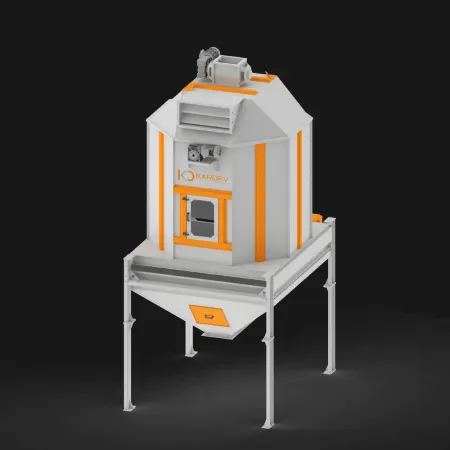
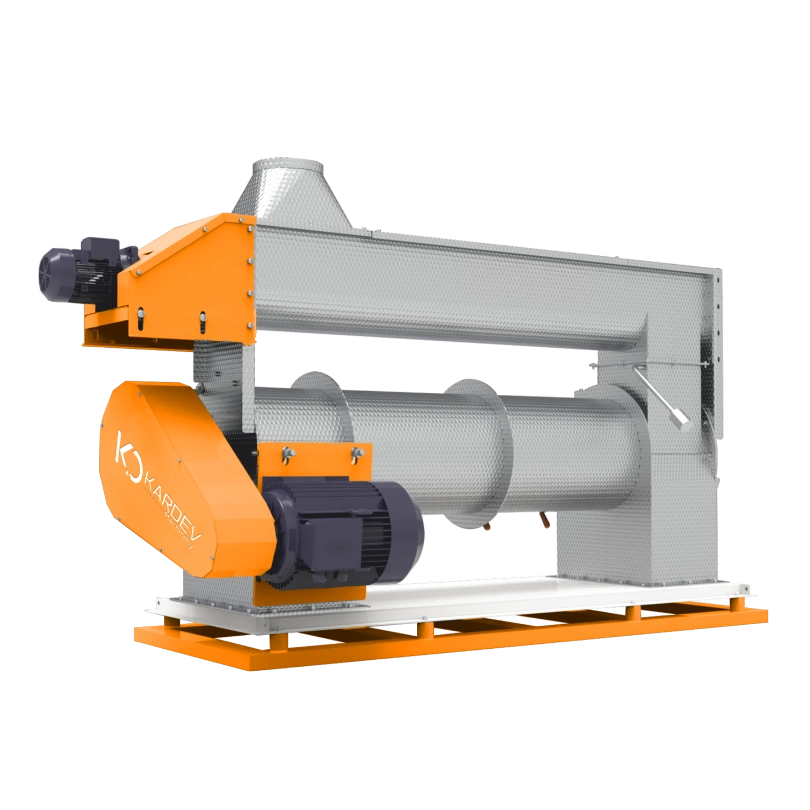
Vertical Mixer
In feed mills, grains such as corn, barley and wheat may be used together in the same feed formulation. When these raw materials are intended to be ground together, pre-mixing may be required before they enter the grinding equipment. A vertical mixer is used at this stage to blend different grains before milling.
The KARDEV vertical mixer is designed for continuous operation. Raw materials circulate inside the mixing chamber while the mixed product is simultaneously discharged through the lower conical section. Since feed mills have different production requirements, KARDEV manufactures vertical mixers in various capacities according to each project.

What Is a Vertical Mixer Used For?
Feeding corn, barley and wheat into the same hammer mill does not necessarily mean that the grains have been sufficiently blended. If the proportion of one raw material changes during feeding, the composition of the material entering the grinding process may also vary.
A vertical mixer is used to pre-mix grains before they reach the mill.
The product prepared at this stage is not the final compound feed mixture. The purpose is to blend the grains included in the formulation before grinding.
Pre-mixing is particularly relevant in feed production lines where different raw materials are processed together in the same grinding equipment.
How Does a Vertical Mixer Work?
In vertical screw mixers, the screw conveyor lifts the grains from the lower section of the mixing chamber toward the top.
The lifted material then falls back into the chamber. As this circulation continues, the different grains are repeatedly brought into contact and mixed.
KARDEV vertical mixers operate continuously. Raw materials circulate inside the chamber while product discharge continues through the lower cone.
For stable operation, the inlet and outlet flow rates must be compatible. If the incoming material flow exceeds the discharge rate, the product level inside the chamber increases. If the discharge rate is higher, the material level decreases.
The feeding arrangement must therefore be adjusted according to the operating conditions of the mixer.
Why Is Pre-Mixing Important Before Grinding?
Grains used in animal feed production may differ in hardness, moisture content and particle characteristics.
When different grains enter the hammer mill separately, these variations can affect the load on the grinding equipment.
Pre-mixing allows the raw materials to be blended before reaching the mill. This can help reduce sudden changes in the composition of the material entering the grinding process.
However, excessive feeding or irregular raw material flow can still disturb mill operation.
For this reason, pre-mixing should be accompanied by proper control of the raw material feed rate.
A vertical pre-mixer does not correct inaccurate ingredient dosing. The required proportions of raw materials must be established before the mixing stage.
Continuous Mixing and Material Circulation
Continuous movement inside a vertical mixer does not necessarily produce the same mixing ratio at every point in the chamber.
The path followed by the raw materials is important.
Grains that remain inside the chamber for a longer period may experience more mixing than grains that reach the discharge outlet earlier.
Mixing becomes more challenging when raw materials have different particle sizes or bulk densities.
These materials may move differently inside the chamber. Smaller particles can accumulate in certain areas, while larger grains may separate from the mixture.
As a result, the machine may continue operating normally even when the composition of the discharged product varies.
For this reason, samples should be collected from the mixer outlet at suitable intervals.
Examining these samples helps determine whether the raw materials are being distributed consistently throughout the mixture.
Material Discharge Through the Lower Cone
In KARDEV vertical mixers, raw materials can be discharged through the lower cone while the mixing process continues.
As the product moves downward, it passes through a narrowing section of the chamber.
The cone angle, discharge opening dimensions and flow characteristics of the raw materials directly influence the discharge rate.
A cone that handles dry, free-flowing corn without difficulty may experience discharge problems when processing materials with higher moisture content or lower flowability.
In some cases, material may accumulate or become compacted directly above the discharge opening.
This can interrupt the flow of raw materials to the hammer mill even when the mixing chamber contains sufficient material.
When accumulation occurs inside the lower cone, increasing the discharge opening is not always the correct solution.
Even with a sufficiently large outlet, the material may adhere to the internal cone surface or form a blockage above the opening.
The cone angle, internal surface characteristics and properties of the raw materials must therefore be considered as part of the equipment design.
How Is Material Flow Maintained in a Vertical Mixer?
Material flow through a vertical mixer is influenced not only by the mixer itself but also by the equipment connected to its inlet and outlet.
If the screw conveyor feeding the mixer delivers raw materials irregularly, the material level inside the chamber can fluctuate.
An unstable product flow toward the hammer mill may appear to be a mixing problem, even when the actual cause is inconsistent feeding before the mixer.
Similar problems can occur at the discharge side.
If the downstream conveyor has insufficient capacity, material may begin accumulating at the mixer outlet.
Increasing the mixer discharge rate will not solve the problem if the following conveyor cannot transport the additional material.
The feeding equipment and downstream conveying system must be designed to handle compatible material flow rates.
Even when the vertical mixer has a high nominal capacity, the actual quantity reaching the hammer mill may be lower.
If an intermediate conveyor has a lower throughput, that conveyor becomes the limiting component of the production line.
Therefore, equipment selection should consider the entire material flow path rather than the mixer capacity alone.
How Is Vertical Mixer Capacity Determined?
The first consideration when selecting a vertical mixer is the required throughput of the grinding line.
For example, if a hammer mill processes 10 tonnes per hour but the upstream mixer cannot supply that amount, the capacity of the entire line may be reduced.
However, knowing the required hourly throughput is not sufficient on its own.
Corn and barley have different bulk densities. The same weight of these grains can occupy different volumes inside the mixing chamber.
The mixer body dimensions must therefore be selected according to the physical characteristics of the raw materials.
Sufficient internal space must also be provided to allow proper material circulation.
Future production expansion, the types of grains to be processed and the capacity of the hammer mill should all be considered during equipment selection.
KARDEV manufactures vertical mixers in different capacities according to the requirements of each feed mill project.
Technical Features of the Vertical Mixer
KARDEV vertical mixers are not limited to a single body size or fixed production capacity.
The machine can be manufactured in different dimensions and capacities according to the requirements of the feed production facility.
Mixer Body Design
The vertical mixing chamber provides the internal space required for raw material circulation.
When determining the body diameter and machine height, both the production requirements and the available installation space inside the feed mill must be considered.
Mixing System
In the KARDEV vertical mixer, raw materials circulate inside the chamber while the mixed product can be discharged through the lower cone.
The mixing chamber does not need to be completely emptied after every material circulation cycle.
This continuous operating arrangement is suitable for feed production lines where grains are prepared for grinding without repeated batch interruptions.
Motor and Drive System
Restarting a vertical mixer when it is filled with raw material may require greater starting torque than starting an empty machine.
The motor must overcome the resistance of the material inside the mixing chamber during startup.
The bulk density and properties of the raw materials can also affect the required motor load.
For this reason, motor selection should consider not only the rated power in kW but also the starting conditions when the mixer is loaded.
Inlet and Outlet Connections
The inlet and outlet connections must be compatible with the material flow requirements of the production line.
Even when the feeding screw conveyor supplies sufficient material, a downstream conveyor with a lower capacity can cause accumulation at the mixer discharge.
In some cases, the restriction may be caused by the dimensions of the connecting outlet rather than the conveyor itself.
A mixer may have sufficient processing capacity but still fail to deliver the required throughput to the hammer mill if the discharge connection is undersized.
Where Is the Vertical Mixer Installed in a Feed Mill?
In feed production lines that use pre-grinding mixing, the vertical mixer is installed before the hammer mill.
Grains are first dosed according to the feed formulation and then transferred to the vertical mixer.
After pre-mixing, the material proceeds to the grinding stage.
The KARDEV vertical mixer is manufactured for this part of the production process.
It is important to distinguish a grain pre-mixer from the main feed mixer.
The vertical pre-mixer blends grains before grinding. The ground materials are subsequently transferred to the main feed mixer according to the plant’s process arrangement.
Other ingredients, such as vitamins, minerals and premixes, are generally introduced and blended during a later stage of compound feed production.
Where Are Vertical Mixers Used?
Vertical pre-mixers are used in feed mills where several grain types are processed together in the same grinding line.
Raw materials such as corn, barley and wheat may arrive from separate storage silos.
When these grains need to be blended before entering the hammer mill, a vertical mixer can be installed upstream of the grinding equipment.
Pre-mixing equipment may also be used in dry pet food and aquafeed production lines, depending on the process requirements.
However, not every grinding line requires a vertical pre-mixer.
A mill processing a single type of grain may have different requirements from a grinding system handling several raw materials simultaneously.
The need for pre-mixing should therefore be determined according to the actual production process.
What Should Be Considered When Selecting a Vertical Mixer?
Two feed mills with the same hourly production capacity may require different vertical mixers.
One facility may process the same grains throughout the day, while another may change its feed formulations several times during production.
Selecting the same mixer for both facilities without considering these differences may not be appropriate.
When selecting a KARDEV vertical mixer, the types of raw materials, frequency of formulation changes and hammer mill feeding arrangement must be evaluated.
The mixer configuration is then determined according to the operating requirements of the facility.
Raw Material Characteristics
A mixer processing clean, dry grains may not perform in the same way when handling materials with higher moisture content or a greater proportion of fine particles.
Changes in material flowability can affect movement inside the mixing chamber.
When raw materials have different bulk densities or particle characteristics, their behavior inside the mixer should be considered during equipment selection.
Feed Formulation Changes
After the mixer is emptied, a certain amount of raw material may remain inside the chamber.
When production switches to a different formulation, this residual material can become part of the next mixture.
In feed mills where formulations change frequently, extended cleaning periods between production runs may be undesirable.
Accessible internal surfaces and practical cleaning arrangements can therefore be important selection criteria.
Mixing Consistency
The fact that a vertical mixer is operating does not necessarily mean that all grains are being distributed in the required proportions.
Mixing consistency should be assessed by examining samples taken from the discharge.
If samples collected at different times show significant deviations from the target grain proportions, the mixing process may not be sufficiently consistent.
For this reason, mixing quality should not be evaluated using a single sample.
Maintenance and Cleaning
Adequate maintenance access should be considered when positioning the mixer within the production line.
If other machinery must be dismantled to reach the drive motor, even routine maintenance may require unnecessary downtime.
Access to the internal mixing chamber is also important.
In facilities with frequent formulation changes, residual material should be removable without prolonged cleaning procedures.
KARDEV manufactures vertical mixers in different capacities according to project requirements. Equipment selection is based on the production process, raw material characteristics and operating conditions of the feed mill.
OTHER PRODUCTS
Quality is never a coincidence.