Industrial Dust Extraction Fan
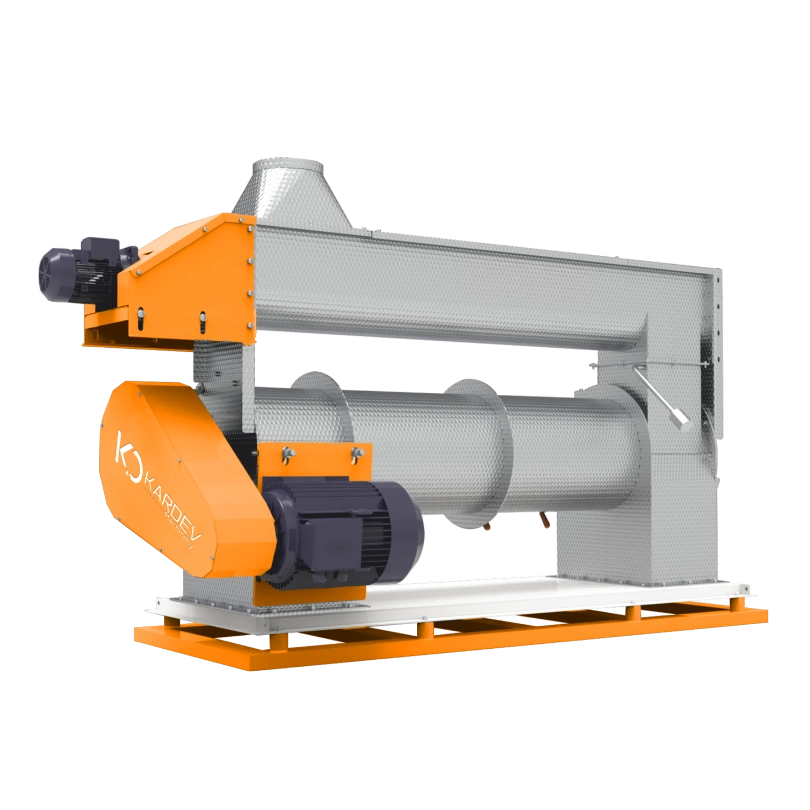
Fans are the main power source of entire dedusting and cooling systems in your plant. They are available with variable motor powers and body sizes with different inlet and outlet dimensions. The type of fan should be chosen due to the volume of the space where is planned to be covered by the dedusting system.
Used together with the equipment such as cyclone, jet filter etc. in the plants. Prevents environmental disturbing by using a silencer in the air discharge assembly.

Dust is generated at many points in a feed mill, particularly during grain intake, conveying, grinding and material transfer. An effective extraction system is needed to capture airborne dust and move it towards the appropriate collection equipment. An industrial dust extraction fan provides the airflow required for this process.
KARDEV Machinery manufactures industrial fans for dust extraction and cooling applications in animal feed production plants. Fans are selected according to the required airflow, operating pressure, motor power and installation conditions. They can be integrated with cyclones, jet filters, hammer mills and pellet cooling systems.
What Is an Industrial Dust Extraction Fan?
An industrial dust extraction fan is designed to generate airflow through a ducted extraction system. It creates a pressure difference that draws air from designated extraction points and moves it towards a dust collection or discharge system.
In feed mills, dust is commonly released when grain moves between bucket elevators, conveyors, storage bins and processing equipment. Extraction fans help capture this dust at the source and transport it through the connected ductwork.
The fan itself does not separate dust from the air. Dust separation takes place in equipment such as cyclones and jet filters. The fan provides the airflow needed to move air through these components.
Industrial fans are also used in pellet cooling applications, where they draw air through hot pellets and carry the heated air away from the cooler.
How Does an Industrial Dust Extraction Fan Work?
An electric motor drives the fan impeller, either through a direct-drive arrangement or a belt-and-pulley transmission.
As the impeller rotates, air enters the fan inlet, gains energy and is directed towards the outlet. The pressure difference created by the fan draws air through the connected ductwork.
The actual airflow depends on several factors, including impeller design, rotational speed and system resistance.
A fan operating with a short duct and limited restrictions may deliver a different airflow from the same fan connected to a long duct with multiple bends, filters and other components.
For this reason, motor power alone is not sufficient to determine fan performance. Airflow and pressure must be considered together.
Centrifugal Fan Design
Centrifugal fans are widely used in industrial extraction systems because they can generate the pressure required to overcome resistance in ductwork and dust collection equipment.
A centrifugal fan typically consists of an impeller rotating inside a housing. Air enters through the inlet and is discharged through the outlet after passing through the impeller.
Impeller diameter, blade geometry and rotational speed influence the fan’s operating characteristics.
For applications involving dust-laden air, the possibility of material accumulation and impeller wear must also be considered.
Applications in Animal Feed Mills
Dust extraction and process cooling require different airflow conditions. KARDEV fans are configured according to the equipment they serve and the requirements of the production line.
Dust Collection and Aspiration Systems
Raw material receiving pits, bucket elevators, chain conveyors and transfer points are common sources of dust in feed production.
Extraction hoods and ductwork collect airborne dust from these locations. The fan maintains the airflow required to transport dust-laden air towards a cyclone or jet filter.
In systems with several extraction points, duct sizing and airflow distribution are particularly important. Poorly balanced ductwork may result in strong suction at one point and insufficient extraction at another.
A properly designed extraction system considers the number of suction points, their operating conditions and the total pressure loss.
Hammer Mill Aspiration
Hammer mills generate dust and air movement during the grinding process. An aspiration system helps manage airflow and direct airborne particles towards the filtration equipment.
In many feed milling applications, the extraction fan operates together with a jet filter.
The required airflow depends on the grinding equipment, production conditions and filter system. Pressure loss across the filter and associated ductwork must also be considered when selecting the fan.
If extraction performance decreases, the problem may not necessarily be caused by the fan. Blocked ducts, dirty filter elements or air leaks can also affect system performance.
Pellet Cooler Air Extraction
Pellets leaving the pellet mill are hot and contain moisture from the conditioning and pelleting process.
In a counterflow pellet cooler, ambient air passes through the pellet bed and removes heat and moisture. An extraction fan draws this air through the cooler and directs it towards the exhaust system.
Dust carried by the exhaust air can be separated using a cyclone.
The airflow requirement depends on the cooler capacity, pellet bed depth and resistance to airflow. Selecting the fan without considering these conditions may lead to inadequate cooling performance.
Cyclone and Jet Filter Systems
Cyclones and jet filters are widely used to separate dust from air in feed production plants.
In a cyclone, the incoming air follows a rotating path that allows particles to be separated by centrifugal action.
In a jet filter, air passes through filter elements that retain dust particles. As dust accumulates on the filter surface, resistance to airflow increases until the elements are cleaned.
The extraction fan must provide sufficient airflow at the operating pressure required by the complete system.
Industrial Dust Extraction Fan Technical Features
KARDEV industrial fans are available in different configurations to suit the airflow requirements and installation conditions of feed production facilities.
Key technical parameters include:
- Airflow Capacity: The volume of air moved by the fan, expressed in m³/h.
- Operating Pressure: The pressure required to overcome resistance in the connected extraction or cooling system, expressed in Pa or mmWG.
- Motor Power: Selected according to the required airflow, pressure and fan efficiency.
- Fan Type: Centrifugal and other suitable configurations, depending on the application.
- Impeller Design: Determined by airflow requirements and the characteristics of the air being handled.
- Drive System: Direct drive or belt-and-pulley transmission, depending on the fan configuration.
- Fan Housing: Dimensions and construction selected according to the application.
- Inlet and Outlet Connections: Designed to match the ductwork layout.
- Maintenance Access: Access arrangements may be provided according to the fan design.
- Noise and Vibration Control: Suitable balancing, mounting solutions and optional silencers can be considered.
Final specifications depend on the intended application and project requirements.
Fan Housing, Impeller and Drive System
The fan housing encloses the rotating impeller and directs airflow towards the outlet. Its dimensions and discharge arrangement must be compatible with the available installation space and connected ductwork.
The impeller is a critical component of fan performance. Proper balancing helps limit vibration and unnecessary mechanical loads on the bearings.
In dusty applications, deposits may accumulate unevenly on the impeller blades. This can cause vibration even when the bearings remain in good condition.
KARDEV fans may use direct-drive or belt-driven arrangements, depending on the configuration.
In belt-driven systems, belt tension, pulley alignment and transmission condition should be checked during routine maintenance. Belt slippage can reduce the actual impeller speed and affect airflow.
Regular inspection of the fan housing, impeller, bearings and drive components helps maintain reliable operation.
How Is Dust Extraction Fan Capacity Determined?
Fan capacity is determined by the required airflow and the total pressure loss of the system.
A single hammer mill extraction line will not have the same requirements as a centralized dust collection system serving several conveyors and bucket elevators.
Important selection factors include:
- Number and location of extraction points
- Required airflow at each point
- Duct lengths, diameters and bends
- Pressure losses across cyclones and filters
- Air temperature and dust characteristics
- Equipment operating conditions
- Simultaneous operation of connected extraction points
The fan is then selected to deliver the required airflow at the calculated operating pressure.
An undersized fan may provide insufficient extraction at critical points. An oversized fan may result in unnecessary energy consumption or operational problems, depending on the system characteristics.
The complete extraction or cooling system should therefore be evaluated before selecting a fan.
What Should Be Considered When Choosing an Industrial Fan?
Application: Determine whether the fan will be used for hammer mill aspiration, centralized dust extraction or pellet cooler exhaust.
Airflow and Pressure: Select the fan according to the required operating point rather than motor power alone.
Dust Characteristics: Consider dust concentration, particle properties and the potential for material buildup or wear.
Duct Connections: Confirm that the inlet, outlet and discharge direction are compatible with the installation.
Energy Efficiency: An appropriately selected fan can help avoid unnecessary power consumption.
Maintenance: Allow sufficient space for inspection, cleaning and access to the impeller, motor and bearings.
KARDEV Industrial Dust Extraction Fans
KARDEV Machinery manufactures industrial fans for the dust extraction and process cooling requirements of animal feed mills.
Fans can be configured for hammer mill aspiration, grain handling systems, cyclones, jet filters and pellet coolers. Motor power, fan housing dimensions, drive arrangement and connection details are selected according to the project.
For a new feed mill or an upgrade to an existing dust collection system, contact KARDEV Machinery with your required airflow, pressure and application details to discuss a suitable fan configuration and request a quotation.
OTHER PRODUCTS
Quality is never a coincidence.