Pellet Crumbler Machine
Feed pellets do not always have the particle size required for every feeding stage. Smaller feed particles are particularly important in poultry production, where standard pellets may be too large for young chicks. A pellet crumbler machine reduces cooled feed pellets into smaller, more manageable crumbles without grinding them completely into powder.
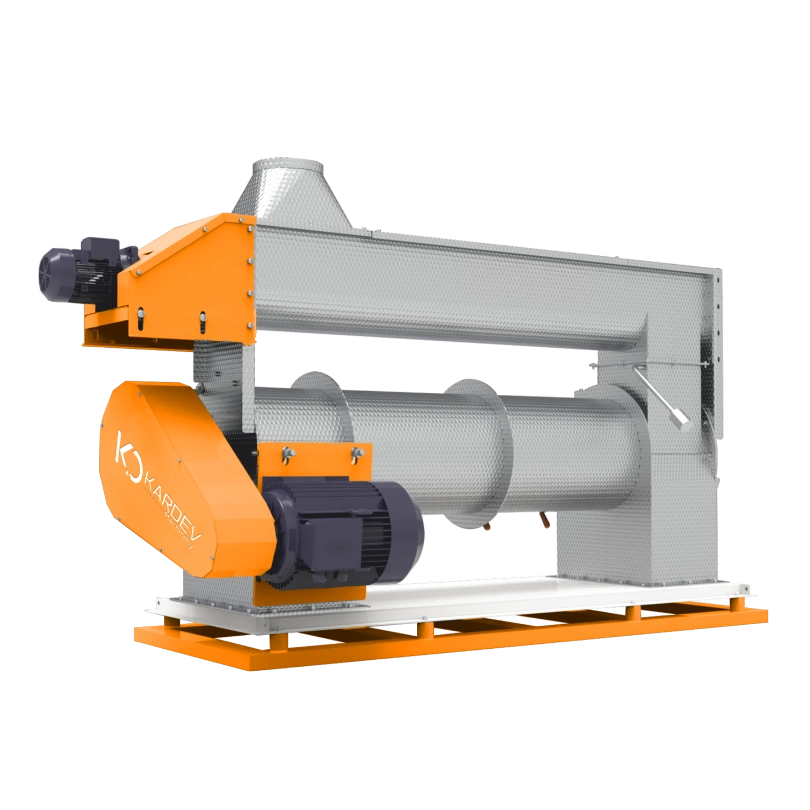
The KARDEV pellet crumbler uses two counter-rotating rollers operating at different speeds to break pellets into smaller particles. Specially designed roller grooves grip the pellets, while the feeding system distributes material evenly across the roller length. The adjustable roller gap allows operators to control the crumble size according to production requirements.

What Is a Pellet Crumbler Machine Used For?
A pellet crumbler machine is used in animal feed production to reduce the particle size of finished pellets. It is particularly useful for manufacturing chick starter feed and other feed formulations that require smaller particles than conventional pellets.
During the crumbling process, pellets pass between two rollers and break into smaller pieces. The objective is to produce feed crumbles of the required size while limiting the formation of excessive fines.
The final particle size depends on several factors, including roller gap, pellet hardness, roller tooth profile and feeding uniformity.
In the KARDEV pellet crumbler, the feeding system distributes pellets across the working length of the rollers. This helps prevent uneven loading and supports consistent crumbling performance.
If excessive fines appear in the finished product, the roller gap should be checked first. An excessively narrow gap may cause unnecessary particle breakage. If oversized particles remain, both roller adjustment and material distribution should be examined.
How Does a Pellet Crumbler Machine Work?
After leaving the pellet cooler, the cooled pellets enter the crumbler feeding section. The feeder distributes the material along the rollers before it enters the crumbling zone.
The pellets pass between two counter-rotating rollers operating at different rotational speeds. The grooved surfaces apply controlled compression and shearing forces, breaking the pellets into smaller feed particles.
In the KARDEV pellet crumbler, the rollers operate at differential speeds, and the distance between them can be adjusted through the SCADA control system.
Reducing the roller gap generally produces smaller crumbles, while increasing the gap allows larger particles to pass through. After crumbling, the material moves to the next stage of the feed production line.
If the discharged material shows uneven particle sizes, roller gap adjustment alone may not solve the problem. The distribution of pellets across the rollers should also be inspected.
Roller Gap Adjustment and Crumble Size
The distance between the two rollers is one of the main factors controlling the finished crumble size.
A narrower gap increases the degree of particle breakage and generally produces finer crumbles. A wider gap produces larger particles, but excessive spacing may allow some pellets to pass through without sufficient crumbling.
The KARDEV pellet crumbler allows roller gap adjustment through the SCADA system. Operators can check the discharged product and adjust the roller spacing according to the required particle size.
Pellet hardness also affects crumbling behavior. Changes in feed formulation, pellet diameter or pellet quality may require the roller gap to be readjusted.
Roller Design and Tooth Profile
The roller tooth profile determines how effectively pellets are gripped and broken during operation.
KARDEV rollers can be designed with different tooth profiles according to the processed material and required crumble characteristics. The differential rotational speed of the rollers helps generate the compression and shearing action needed for pellet crumbling.
Over time, roller surfaces may become worn. Worn teeth can reduce the effectiveness of the crumbling process and may increase the proportion of fine particles.
If crumble quality deteriorates despite correct roller gap settings, the roller surfaces and tooth condition should be inspected.
Bypass System
Not every production batch requires pellets to be converted into crumbles.
When conventional pellet feed is being produced, the material can pass through the machine without entering the crumbling rollers.
The KARDEV pellet crumbler includes a bypass flap that directs pellets around the crumbling section. This allows the same production line to handle both whole pellets and crumbled feed.
Why Are Feed Pellets Converted into Crumbles?
Standard feed pellets may be too large for young poultry, particularly during the early feeding stages. Crumbling reduces pellet size and produces particles better suited to the feeding requirements of chicks.
Unlike grinding, the crumbling process does not aim to turn the entire pellet into fine powder. Instead, it breaks the pellets into smaller particles while preserving much of the compact structure developed during pellet production.
This allows feed producers to obtain smaller feed particles while retaining important benefits associated with pelletized feed.
Particle size control is essential. Excessively fine material can increase dust levels, while oversized particles may not meet the intended feed specification.
For this reason, both crumble size and the percentage of fines should be monitored at the machine outlet.
How Are Uniform Feed Crumbles and Low Fines Achieved?
Uniform crumbling requires consistent feeding, suitable roller adjustment and properly maintained roller surfaces.
Pellets should be distributed evenly across the roller length. Uneven material flow can overload one section of the rollers while leaving other sections underutilized. This may affect both machine capacity and product consistency.
If the finished product contains excessive fines, the roller gap and roller condition should be checked. If too many large particles remain, the degree of crumbling may be insufficient.
Pellet hardness is another important factor. Two feed formulations can produce different crumble characteristics even when the machine operates with the same settings.
Regular sampling of the discharged material helps operators evaluate particle size distribution and make the necessary adjustments.
Where tighter particle size control is required, a downstream screening system can separate oversized particles and excessive fines from the acceptable product.
What Determines Pellet Crumbler Capacity?
Pellet crumbler capacity should be selected according to the output of the pellet production line.
The crumbler must be capable of processing the material received from the pellet press and cooler without creating a bottleneck in the production process.
Roller length is an important factor. Longer rollers provide a wider working surface and can accommodate a greater material flow when the feeding system distributes pellets correctly.
Roller diameter, rotational speed, tooth profile and pellet characteristics also influence the machine’s operating capacity.
The required crumble size must also be considered. Fine crumbling requirements, pellet hardness and material characteristics may affect practical throughput.
Therefore, machine capacity should be evaluated according to actual production conditions rather than roller dimensions alone.
Technical Features of the KARDEV Pellet Crumbler Machine
The KARDEV pellet crumbler is designed for controlled particle size reduction in industrial animal feed production lines.
Its main technical and functional features include:
- Two crumbling rollers: Counter-rotating rollers break cooled feed pellets into smaller particles.
- Differential roller speeds: Different rotational speeds provide the compression and shearing action required for effective crumbling.
- Adjustable roller gap: The spacing between the rollers can be adjusted through the SCADA control system to control crumble size.
- Application-specific tooth profiles: Roller tooth geometry can be selected according to the processed feed and required particle characteristics.
- Belt and pulley drive system: Power is transmitted to the rollers through a belt and pulley arrangement.
- Uniform feeding system: The feeder distributes pellets across the roller length to support consistent operation.
- Bypass flap: Whole pellets can pass through the machine without entering the crumbling section when crumbled feed is not required.
Roller dimensions and machine configuration are selected according to production capacity, pellet characteristics and the required finished product.
During operation, roller gap adjustment should be evaluated together with feeding uniformity and roller surface condition.
Applications in Animal Feed Production Lines
Pellet crumblers are commonly installed after the pellet cooler in industrial feed production lines.
After cooling, the pellets enter the crumbler. When crumbled feed is required, they pass between the rollers and are reduced to smaller particles. When whole pellet feed is being produced, the bypass system directs the material around the crumbling section.
The finished crumbles can then be transferred to a screening machine, such as a vibrating sieve, to separate excess fines and oversized particles where necessary.
Material within the required particle size range proceeds to the finished product silo or packaging section.
Pellet crumblers are particularly useful in poultry feed plants producing chick starter feeds and other products requiring controlled particle sizes.
The machine should be integrated into the production line according to the capacity of the pellet press, cooler and downstream equipment.
What Should Be Considered When Choosing a Pellet Crumbler?
Selecting a suitable pellet crumbler requires evaluating production capacity, required particle size, roller configuration and material flow.
Production Line Capacity
The hourly production rate of the pellet press is the starting point for machine selection.
The crumbler should process the incoming material without causing accumulation at the inlet or restricting the output of the production line.
Roller Length and Diameter
Roller length influences the available working area and the amount of material that can be distributed across the rollers.
Roller diameter affects pellet engagement and the crumbling process. Both dimensions should be evaluated together with roller speed, tooth geometry and the required production capacity.
Tooth Profile and Roller Material
The roller tooth profile affects how pellets are gripped, compressed and broken.
Tooth geometry should be selected according to pellet characteristics and the required crumble size. Roller material and surface wear resistance are also important for long-term operation.
Feeding System
The feeder should distribute material consistently along the roller length.
If pellets are concentrated on one side, that section of the rollers may carry a greater load while the remaining working surface is underutilized.
Uniform feeding supports stable throughput and more consistent product quality.
Bypass Arrangement
A bypass system is important for production lines that manufacture both conventional pellet feed and crumbled feed.
It allows operators to direct whole pellets to the next processing stage without passing them through the crumbling rollers.
Roller Gap Control
The roller gap should be adjustable according to the required particle size.
In the KARDEV pellet crumbler, SCADA-based adjustment allows operators to modify the roller spacing and monitor the resulting product.
Whenever pellet characteristics or feed formulations change, the finished crumble size should be checked and the roller settings adjusted if necessary.
For pellet crumbler selection and integration into an existing or new feed production line, contact KARDEV to discuss production capacity, pellet specifications and the required crumble size.
OTHER PRODUCTS
Quality is never a coincidence.